Monthly Archives: April 2010

Feathered dinosaurs may have changed coats

Some of the most exciting finds of the last couple of decades were the discovery of feathered dinosaurs. These fossils mostly have come from fine-grained formations of the Cretaceous Period in China, where feather impressions were preserved along with the bones. Each of these fossils gives us a snapshot image of the body covering sported by that species. Other recent finds have even given us clues to the coloration of the feathers in a few species.

In yet another new find, announced in the April 29 issue of Nature, we learn that the feathery covering may have fundimentally changed over the lifetime of individuals of at least one species. Two small oviraptors in the genus Similicaudipteryx were preserved at different stages of their life history, each showing the pattern of feathers covering the body at different life stages.
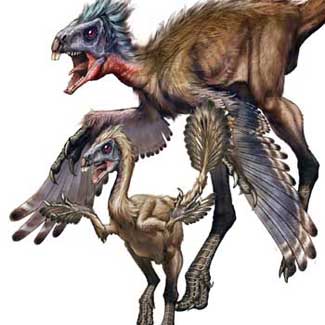
Artist reconstruction of a juvenile and adult Similicaudipteryx

Artist reconstruction of a juvenile and adult Similicaudipteryx. Artwork by Xing Lida and Song Qijin

The smaller, juvenile individual had short flight feathers with a “ribbon-like” stem on its forearms, much long feathers on the tail, and a downy covering over the rest of its body. The larger, young adult individual showed a different pattern, with much longer, and more developed flight feathers with a strong central shaft on the forearm. Thus, the flight feathers of the forearm show two very different morphologies at the two life stages. This does not happen in modern birds, where the flight feathers that emerge on the juveniles are the same, only smaller versions of the adult feathers.

There is some debate that this interpretation of the fossils is correct. It could be, argue some paleontologists, that the smaller individual was preserved during a molting phase, with the new feathers only partially emerged from the tube-like sheath that feathers form in. In other words, they suggest that the different morphology is only temporary and an artifact of preservation. The authors of the original paper maintain it is not an artifact based upon the proportions of the feathers. So, we need to keep digging.

It is now accepted that the ancestors of birds were the theropod (meat-eating) dinosaurs. It is clear from these fossils, and many similar ones, that birds inherited their feathers from dinosaurs, and we have greatly expanded our knowledge of feather evolution with the last few years.

Other dinosaur related posts can be found here. Just search or select the category.

Creating a playground in your yard

Have you been trying to figure out a way to get your kids out of the house?  Let’s face it—these days kids just aren’t as active as they used to be, and when we are so busy ourselves, it can be hard to get them out of the house and away from the TV, the Xbox, or any other of the gadgets that we’ve bought to distract them.

One way to inspire your children is to start putting together a homemade playground in your backyard.  Look outside and think about it.  A lot of us have nothing more in the yard but a flat, pristine stretch of lawn or some gravel and a broken down car.  Not exactly inspiring for play, so unless you want them wandering off who knows where.  It’s time to make something in the direct vicinity of your home that will drag them outdoors.

Here are some simple things to get you started.

Trampolines

A trampoline is probably the simplest way to immediately make your yard a kid’s heaven, and even if you didn’t add anything else, they will be tempted to run out and use it for years, even far into their teens.  Trampolines are an amazing source of physical activity that have proven to be even more beneficial than a cardio routine, and kids like to do all sorts of stunts on them, making them lot of fun.

Just be sure to consider safety first when choosing the model for your yard.  A lot of the older ones have proven to be quite dangerous, so look for a newer design, like the springless trampoline.

Slides

What kid doesn’t love a slide?  This is a rather cheap addition to your background playground.  If you’ve already got a pool installed, this can be a way to really make it that much more of a blast.

Swing sets

While certainly not as versatile or captivating as a trampoline, swing sets will always hold their allure for children.  A moment in your backyard giving them a push can be the simplest of bonding experiences, and you will likely find yourself sitting in the seat for a little rocking back and forth as well.  If you’ve got a big back yard and some sturdy trees, save some money by putting up a strong rope or tire swing.

Pools

I realize not everyone can afford an Olympic size swimming pool in the backyard, but all you need is something that can hold some water.  There are plenty of above-ground pools that provide plenty of fun for kids who just want to get wet in the heat and splash around a little bit.

Those are just a few simple ideas.  The point is to start thinking about how you can make your backyard more inviting to kids, and then you won’t have to nag on them to get them outside—they’ll go all on their own.  Sure, they’ll still spend some time playing games on the Xbox, but their lives will begin to alternate between the inside and outside world rather than resembling the life of a couch cushion.

Start adding components like these one at a time as money allows—trampoline, swing, pool—and before you know it, your backyard will be the most exciting place in town.

Denning behavior in the Giant Short-faced Bear

One of the most exciting things in paleontology to me is when we can begin to tease apart how extinct animals, animals that humans often never set eyes upon, lived their everyday lives. I am often amazed at how my colleagues can drill deep into questions that at first seem unanswerable; using creative ways to get answers from all the evidence that has survived, the bones, teeth, and sometimes trace fossils.

There are many examples of using the clues provided in the fossil record to come to better understand beasts from the past. In an earlier story, we looked at a disease process in Tyrannosaurus, and glimpsed how the mighty tyrant king could be brought down by a lowly protozoan. Here, we will explore some evidence for denning in the Giant Short-faced Bear (GSFB).

In a paper from several years ago Schubert and Kaufmann (2003) discussed the discovery of a GSFB in an Ozark cave. While incomplete, it is still one of the most complete specimens of the bear ever found. In addition to bones in partial articulation, they also found a thin layer of clay and minerals underneath the skeleton that preserves the remains of hair. Unfortunately, the hair is too deteriorated to tell us what color it was or exactly what its texture might have been, but its discovery is tantalizing.

This Ozark specimen is small compared to others of its species. There is a lot of evidence that there was a significant difference in size between male and female GSFBs. For example, at Rancho La Brea in southern California, both smaller and larger individuals have been found in contemporaneous deposits. It is easy to tell if the individuals are adult, so seeing large and small forms suggests two options: either there are two species, or there is one species with large and small individuals. It later is most likely. This is not surprising as all modern bears are sexually dimorphic.

Schubert and Kaufmann noted that over 1/3 of the known specimens of the GSFB come from caves, and that those specimens are smaller in general than the specimens found in open environments. (See the story about the type specimen, also found in a cave in northern California). It is logical to reason that the smaller individuals using the caves are predominately female.

Modern female bears are much more prone than males to den during periods of unfavorable conditions. And male bears are more likely to remain active throughout the year. It seems as if the GSFB followed a similar pattern—the females were using caves as denning sites, and were denning when they perished. In Cope’s original paper (1879), he called this new animal the cave bear of California—seems he was right.

From the accumulation of small bits of information we continuously piece together the lives of prehistoric beasts, slowly bringing them into sharper focus. That is the thrill of paleontology.

Cope, E. D. 1879. The cave bear of California. American Naturalist 13:791.
Schubert, B. W., and J. E. Kaufmann. 2003. A partial short-faced bear skeleton from an Ozark cave with comments on the paleobiology of the species. Journal of Cave and Karst Studies 65(2):101-110.

There are many other interesting facts here at Boneblogger. Just look around and enjoy.

Fireworks pictures–in the sky

Pictures in the night sky made from light have always fascinated people.  The ancients looked at the stars and created pictures that incorporated the different constellations in them.  Now we can use chemicals to create our own ephemeral and beautiful pictures in the night sky.

Not only can we recreate a simulation of the Pleiades meteor shower, we can recreate it in much denser form and in a multitude of colors.  The fun only begins with that image.  There are twinkling star shapes in reds, blues, greens, and yellows.  Umbrella formations grace the night with their flowing images.  Balls of light, which look like we are seeing the creation of the universe in a big bang that expands across the sky.  Puffballs of exotic flowers bloom quickly then fade away, leaving room for the next spectacular fireworks picture.

Palm trees that sparkle in a lovely array of colors grow, expand and disappear before our eyes.  Flowers bud, blossom and fade before our eyes.  A hacky-sac in magenta appears out of the darkness, glowing with a promise of more beauty coming behind it.  A whirling whiz-bang shoots off sparks in every direction.  Rockets pierce the sky, throwing sparkles of colors in every direction.   Colored fountains grow and sparkle, showering beauty on us all.   When the fireworks pictures occur in the sky over a still lake or pond, we get a doubling of the wonderful images that are created.

When there is a backdrop for stationary fireworks, pictures can be built such as a plant growing into a bush, then a rose budding and blossoming.  Surrounding the rose in a semi-circle can be a group of Scottish thistles as was described in one of Louisa May Alcott’s books.  The possibilities are endless.  No matter what you would like to see in a gorgeous array of lights, fireworks pictures can provide it.  The fleeting nature of these wonderful images only makes them more precious.

Snails in an aquarium

There was a time when snails were thought to be necessary to have in a home aquarium. The idea was that the snail would clean up the fish droppings and the snail droppings were good for the plants. The plants in turn would give off oxygen that would help keep the fish healthy.

The reality is that the snails don’t eat the fish dropping, and the snail droppings add to the tank debris. Plants can utilize some of the droppings but the rest must be cleaned up by the filtration system. Plants do give off oxygen during the day, but the fish are not dependent upon that oxygen source if you have a good filter that is aerating the water.

The filtration system in the aquarium cleans up the animal matter and provides the necessary aeration to the fish tank. So what do snails do? They clean up excess fish food that would otherwise foul a tank. They help by eating some of the algae that adhere to the tank walls. They eat on the eggs of the fish, breaking them up but not consuming all of the egg before they move on to the next. Snails will also eat on the plants. Most of them usually do not eat the whole plant. They make holes in the plant, weakening them and disturbing the ambiance of the aquarium décor.

There are hundreds of snail species. The most common snails which are most likely to find their way into the aquarium as a stowaway on plants and live food is the Pond Snail. Most of them are prolific breeders. It is necessary to thin the snail population from time to time or they will consume the tank plants. The easiest way to thin the population is to crush them. Many fishes will eat the crushed snails and benefit from the live food.

Some fish breeders raise snails as a source of fish food. Not only will larger fish eat crushed snails, but the snails will help produce infusoria, a collection of tiny single-celled and multi-celled organisms that very small fish can eat. The Apple snails are a common group used to help start infusoria. The snails eat large quantities of plant material, such as lettuce. They produce a large amount digested waste that is a wonderful source of food for infusoria*.

*The use of infusoria was mentioned in an earlier posting.

Related posts:
Aquarium backgrounds
Breeding fish in a home aquarium
Experiences in setting up a home aquarium
Essential advice for starting a home aquarium
Aquarium gravel and water
Aquarium stands, options and considerations
There are many other fun interesting facts here at Boneblogger.