Monthly Archives: May 2010

For Those Not into Weight Lifting: Hamstring Exercises without Weights

The reason why a lot of people are discouraged from exercising is the use of weights and machines, especially with what they see on advertisements. But of course you can perform exercises even without weights or machines; you just have to be resourceful and creative. You may even find that there are exercises specifically developed so you won’t need anything else but just your body movements to execute them.

You can perform the following hamstring exercises without weights:

1.    Dead lifts use only your body weight for resistance. Stand with your feet apart and pointing forward. Bend your knees a little, your arms hanging loosely in front of you. Keeping your spine straight, bend at the waist to lean forward and reach the floor. If your hamstrings aren’t too tight, you may be able to touch the floor. Push through your heels, buttocks, and hamstrings to return to standing position. Do 2 sets of 20 reps each. Progression: do it one leg at a time.

2.    Ball hamstring curls are done by lying on your back with your legs straight and your feet on top of a stability or Swiss ball. Squeeze your buttocks and lift your hips. While pushing into the ball and bending your knees, roll the Swiss ball under your hips. Extend your legs straight once more while your hips are still in the air. Do 10 reps initially, followed by 3 sets of 15 reps each.

3.    Lying hamstring curls are done by folding your arms and relaxing your head on your arms. With your legs straight, bend your left leg and let your heel touch your buttocks. Return to starting position and do it with your right leg. Do 10-20 reps with each leg.

Remember to warm up before and cool down after whatever exercise you do. Work on these exercises regularly and you’ll have improved hamstrings—and glutes—in no time.

Solar Pathway Lights Info

Many choices are available to consumers when shopping for exterior home lighting. Indeed, whether it is choices in finish, material, size, or shape of the exterior home lighting, choices are plentiful. One type of application of exterior home lighting is pathway lighting. Similar to choices in the broader category of exterior home lighting, pathway lighting is available in different designs, whether considering the design from an aesthetic perspective, or whether considering the design of the lighting from the power source design perspective. While some homeowners initially focus on the aesthetics of the pathway lighting, they may also want to consider the power source the lighting uses to illuminate. This article briefly discusses solar pathway lights.

Solar pathway lights operate by utilizing the sun’s energy to provide illumination. The solar component of these lights is designed to harness the sun’s energy during the day and emit it at night. Thus, no electricity is used in this design. However, in order for these lights to function as designed, the solar panel component of the lighting fixture must be placed in the sunlight, so that they harness the sun’s energy. If solar pathway lights, specifically the solar panel component of the lighting, are installed in locations that are not sunny, or blocked from the sun by objects, this type of lighting will not work well with current solar pathway technology. These lights are designed to be installed in sunny locations.

Therefore, if consumers are considering installing pathway lighting on the walkways of their property, and the lights will be installed in sunny locations, solar pathway lighting may be a good option for them. Benefits of solar pathway lighting include that they tend to be easy to install, are ecologically friendly, given they use no electricity in their design, and because they use no electricity in their design, they do not add to the electricity bill.

© 2009 Clearhomelighting.com. All Rights Reserved Worldwide.

Pondering a Future with Natural and Cheap Electricity

Given the current state of the economy and our increasing needs for energy, one may wonder how we are going to be able to meet our energy needs in the future. It would seem that we will need to find a source of abundant, cheap electricity if we are going to continue to grow as a technological society. So, where is this electricity going to come from?

It is almost certainly not going to come from fossil fuels like oil and coal. While these remain among the lowest cost sources of electricity today, and coal in particular may be the cheapest electricity supplier at present, the problem is that all fossil fuels must be extracted from the earth. As the easy to reach reserves are used up, it will become more and more expensive to extract what is left. This is without even mentioning the expense of cleaning up oil spills and other disasters that may be caused by the extraction of fossil fuels. In any case, fossil fuels will only become more expensive, and there is little chance that they will provide the cheap electricity that we will need to power a prosperous society in the future.

As a result, it makes sense to look to natural sources of electricity as a potential source of inexpensive power in the future. The atmosphere and ocean contain huge amounts of energy in the form of wind, waves, and tides, and wind is already a relatively cheap source of electricity in regions where strong, steady wind blow. Much research is currently being done on extracting energy from waves and tides, and we can look forward to much progress on these sources of energy in the coming decades. The sun provides an even more vast source of energy, as all of the motion in the atmosphere and ocean owes its existence to heating from the sun. While the photovoltaic technologies that are currently in existence to produce electricity from solar power are quite expensive, much research is also being done to make solar electricity cheaper.

Because of the existence of so much energy in the natural world, and this energy is constantly being replenished by the input of solar energy, it makes sense to look to this natural energy as a source of cheap electricity to allow our technological society to grow in the future. We need to continue to fund the research into renewable energy generation that will make this future a reality.

Dinosaurs dragging their bellies—Huh?

Isaac Newton famously wrote in 1676,“If I have seen further it is by standing on the shoulders of Giants.” This gets to the heart of the scientific process—a gradual addition and refinement of human knowledge and understanding of the natural world. But, of course, sometimes even giants had wacky ideas.

The particular “giant” to whom I refer is Charles H. Sternberg, famed fossil collector. Sternberg began collecting fossils when he was seventeen, at a time when it was not exactly commonplace, in about 1867. And he dedicated his life to this unusual pastime, founding a family of fossil collectors when his sons continued the tradition for a second generation. Together, the Sternberg family collected a huge number of fossils for museums and science. There is hardly a major museum in the world that does not have one of their discoveries on display.

Sternberg started his career in the hills of western Kansas, collecting fossil plants from the Dakota Formation. He sent his specimens back to the young Smithsonian Institution, for which he received a letter of acknowledgment that he treasured his whole life. He was bitten by the “fossil bug.”
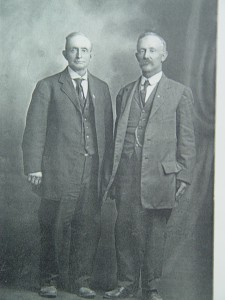
Edward and Charles Sternberg

A rare photograph of Charles Sternberg (right) with his twin brother Edward (left).

By 1875, he enrolled in college where he studied briefly under Benjamin Mudge. Mudge organized a fossil collecting trip for 1876 to collect for O. C. Marsh, the Yale College paleontologist. Sternberg was too late to sign up with Mudge, and bitterly disappointed, and somewhat brazenly, he wrote a letter to Edward D. Cope, Marsh’s rival.

Sternberg wrote, “I put my soul into the letter I wrote him, for this was my last chance. I told him of my love for science, and of my earnest longing to enter the chalk of western Kansas and make a collection of its wonderful fossils, no matter what it might cost me in discomfort and danger. I said, however, that I was too poor to go at my own expense, and asked him to send me three hundred dollars to buy a team of ponies, a wagon, and a camp outfit, and to hire a cook and driver. I sent no recommendations from well-known men as to my honesty or executive ability, mentioning only my work in the Dakota Group.” (Sternberg 1909, pg 33).

Sternberg anxiously awaited a reply, and when he opened Cope’s letter, a draft for $300 fell out, a very significant sum. So began his professional fossil hunting career. Over the years he collected throughout the American and Canadian west. In the twilight of his career he semi-retired to San Diego, and was allowed to use the title of curator at the natural history museum.

Museums and libraries are marvelous places, full of fascinating treasures. It was while reading in the archive at Fort Hays State University’s Forsyth Library that I came across a carefully saved clipping of an article from the  Los Angles Time Sunday Magazine from December 20, 1931, titled “The habits of dinosaurs,” written from an interview with the 80 year old fossil collector.

In the article, Sternberg is quoted as giving his vision of the life of some of the dinosaurs that he had collected over the many years. While I recognize that it is not really fair to judge the views of earlier experts, especially with the perspective of almost three quarters of a century of additional knowledge, but it can be damn funny.

Sternberg is quoted as authoritatively saying, “Dinosaurs were lizards. They stood and walked like lizards, not like elephants or rhinos. That is to say, the normal positions of their feet were outside the line of the body, just like the alligators of today, not inside or even with the line of the body, as are the feet of horses, elephants and other mammals. Moreover, the dinosaur, instead of standing up, on straight legs, as usually pictured, bent its legs outward, as do the lizards, and dragged it belly on the ground, again like the alligators, monitors and other large lizards of the present day.”

Dinosaur reconstructions of that period typically showed dinosaurs with spindly, lizard-like limbs, and tails dragging, but with a generally upright posture. Sternberg evidently did not agree, arguing in favor of his views with some odd reasoning.

Citing fossils of preserved dinosaur skin, he said, “Furthermore, the skin on the lower side of the abdomen of this dinosaur was much thinner and more delicate than on other parts of the body. This is further and strong argument for my claim that the dinosaur dragged its belly on the ground, as do the alligators of today, which so protect their vital parts from carnivorous animals…you may be sure that no tender-stomached dinosaur, whether it weighed forty tons or forty pounds, would voluntarily expose its tenderest and most vital parts to attacks by the tyrant dinosaur or any other carnivorous creature by walking erect.”
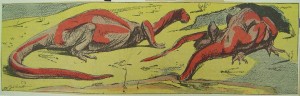
Illustration from Los Angles Times Sunday Magazine, 1931

Illustration from Los Angles Times Sunday Magazine showing Sternberg's idea of dinosaur stance.

I totally agree. I hate walking around with my “tenderest” parts exposed. The accompanying illustration of Sternberg’s vision of the Mesozoic is hilarious, with giant sauropod (long-necked) dinosaurs hunkered down, presumably guarding soft spots. I am not really sure how Sternberg expected it would work for a forty ton animal to push itself along the ground with its legs sprawled out to the side, much less how it would support its own weight on its chest, but details, details.

Even though the article claims that Sternberg was a “man of facts and not fancies,” he was prone to exuberant musing about the prehistoric beasts he collected. While he could be wacky, we owe a great debt to the entire family for their contributions to science.

Further reading about the Sternberg family:

Everhart, M. Oceans of Kansas website, summary of the work of Charles H. Sternberg.

Everhart, M. J. 2005. Oceans of Kansas: A Natural History of the Western Interior Sea. Indiana University Press, Bloomington.

Liggett, G. A. 2001. Dinosaurus to Dung Beetles: Expeditions Through Time, Guide to the Sternberg Museum of Natural History. Sternberg Museum of Natural History, Hays, Kansas.

Rogers, K. 1991. The Sternberg Fossil Hunters: A Dinosaur Dynasty. Mountain Press Publishing Company, Missoula, Montana.

Sternberg, C. H. 1909. The Life of a Fossil Hunter.

Other interesting dinosaur facts are found here at Boneblogger. Search or select the category for more.

Sternberg, C. H. 1917. Hunting Dinosaurs in the Bad Lands of the Red Deer River Alberta, Canada. Charles H. Sternberg, San Diego.

Forklifts for Sale: Moving Gravel, Rock, & Concrete

What is one of the main common denominators between; concrete, gravel, and rock? The answer to this question is obvious they are all back breaking when they have to be moved.

No matter the project, whether it is; a new retaining wall, instilling a driveway, a decorative gravel walkway, or a rock garden moving the material is always a chore. The material is heavy and often times dirty or dusty. For this reason it is a good idea to have a forklift on hand or know where to find forklifts for sale.

Having the proper equipment to move the material is a must. Most places that you get the material from use many different types of equipment to get it moved. These pieces of equipment can be; forklifts, back hoes, bobcats, and many others.

When someone orders the material from a supplier they usually have it delivered to the project site. When the truck arrives with the material it is usually deposited in one central location. It is then the responsibility of the people performing the work to transport the material to the exact location that it is needed. During this part of business, it is a good idea to have some forklift attachments on hand. If you don’t have the proper equipment, look for forklift attachments for sale.

To do this by hand is next to impossible. Even with the use of a wheelbarrow the person doing the work will soon be sore and tired. This is where the use of proper equipment comes in.

Depending on your application will determine the proper equipment to purchase or rent. Often times a bobcat (or similar equipment) will be the best choice for most smaller jobs. The reason for this is the attachments available for this type of equipment. If you have pallets of stone or concrete block you can use the forklift attachment. If you have to have stone or gravel moved you can use the bucket attachment. Often times when doing a project you will have a combination of materials will be used. The ease of changing the attachments makes this equipment that much more desirable.