Monthly Archives: June 2010

Number of venomous snakebites a year and pitfalls in scientific research

While doing a literature search for another story I encountered a classic pitfall in scientific research that one can all too often find. I wanted to know how many venomous snakebites occur each year, and of those, how many are fatal.

I dug into the literature to see what was there. My first stop was Wikipedia. With experience, I have learned that for science issues, Wikipedia is often very good. The wiki format mirrors the scientific publication process where contributors double check facts and each other, and on subjects that I know something about I find it to be a good general source.

I found a statement that there are approximately 7,000 – 8,000 people bitten by venomous snakes each year, and of those about 5 die. Even better, this statistic was given a reference (Henkel ?), as well it should. So, being curious about the original research, I looked up the citation. And here is where the pitfall begins.

In order to conduct science and add to human knowledge we must necessarily build on the work of others. One of the characteristics of science is that results must be repeatable—that is, in theory I could redo the work of any other scientist and get similar results. It is impractical for me to begin every research project by completely re-doing the work of all those researchers before me, so we cite their work and trust in it. (This also explains why scientists can be vicious anytime someone is caught fudging results—we have to be able to trust each other). However, sometimes you encounter what I will call the “chain of citations” pitfall.

copperhead

A copperhead snake, Agkistrodon contortrix, perhaps one of the most beautiful snakes in North America.

This pitfall is in the sloppy application of the scientific process, not with the process itself, and happens I guess out of laziness. It is where an author cites a point of fact from a research paper which may reference the fact (secondary source), but was not the paper where the research was presented in the first place (primary source).

I looked up Henkel and it turns out to be an interesting blurb from an appendix on safety, and he cites Gold et al. (2002), an article with the promising title “Bites of venomous snakes.” Ah, I think, here is the original research, so I look it up.

Those authors say “The true incidence of bites by venomous snakes in the United States is probably 7,000 to 8,000 per year, of which 5 or 6 result in death,” (pg 347) but they cite other authors for this fact, Langley and Morrow (1997).

This is getting silly, I think. How deep does this rabbit hole go? So I look up Langley and Morrow (1997).

The Langley and Morrow paper is a summary of deaths caused by animals of all kinds between 1979 through 1990. They compiled data from the US Department of Health and Human Services as published in Vital Statistics of the United States. They found that an average of 157 deaths occur each year as a result of injuries from animals, and about 60 of those came from venomous animals of all kinds, the majority being bees and wasps. They found an average of 5.5 deaths from venomous snakebites (Langley and Morrow 1997, table 2).

So, here at least we do have some original research on the number of fatalities each year. But how many bites? Langley and Morrow say “Approximately 45,000 snakebites occur each year, of which 8,000 are inflicted by venomous snakes,” (pg 12) and they cite Gold and Wingert 1994. Ok, let’s see what they say.

Gold and Wingert (1994) say “Approximately 45,000 snakebites occur in the United States each year. Poisonous snakes account for an estimated 8,000 of these bites, which result in approximately 9 to 15 fatalities,” (pg 579) and they cite Parrish (1966).

Finally, with Parrish (1966) we got to a paper that tries to determine not just the number of deaths from snakebites, but how many snakebites there are. Parrish (1966) conducted a survey of hospitals and physicians in both 1958 and 1959 to determine the number of snakebite victims treated. He sent questionnaires to a representative sample of both, and based upon the results, extrapolated to the total number of bites.

He wrote “On the basis of all these various reports, I estimate that approximately 6,680 persons in the United States (excluding Alaska and Hawaii [they don’t have venomous snakes]) were treated for poisonous snakebites during 1959,” (pg 272).

There are two numbers I cannot find in Parrish: 45,000 total snakebites and 8,000 venomous snakebites. I have no idea where these numbers originated since all the authors cite it, and all references point back to Parrish. Maybe the 45,000 number is a wild guess, and 8,000 is some adjustment to Parrish’s 6,680 number based on population growth? There is no way for me to know.

But this clearly shows the danger of relying on what the last guy reported and citing him as the authority when that is not what his paper was about. I tell my students to find the original publications and this is why. The number of deaths per year (about 5) is reasonably documented with the work of Langley and Morrow (1997), and in a more recent follow up study (Langley 2005). But, how many venomous snakebites occur in the United States in a year? Based on this evidence, we do not have a clue.

So here is a research tip, free of charge, to all you young budding scientists: go find the answer—just send me a copy of the results. Scour the literature to see if I missed something. Then, determine a good way to address the question and see if you can improve our understanding. The most recent data are over 40 years old, and inquiring minds want to know.

This post is in the dangerous animals series. Check out that post for more information.

Gold, B. S., and W. A. Wingert. 1994. Snake venom poisoning in the United States: A review of theapeutic practice. Southern Medical Journal 87(6):579-589.

Gold, B. S., R. C. Dart, and R. A. Barish. 2002. Bites of venomous snakes. New England Journal of Medicine 347(5):347-356.

Henkel, J.? For goodness snakes! Treating and preventing venomous bites. U.S.D.A. emergency response.

Langley, R. L. 2005. Animal-related fatalities in the United States–an update. Wilderness & Environmental Medicine 16:67-74.

Langley, R. L., and W. E. Morrow. 1997. Deaths resulting from animal attacks in the United States. Wilderness & Environmental Medicine 8(1):8-16.

Parrish, H. M. 1966. Incidence of treated snakebites in the United States. Public Health Report 81(3):269-276.

Geologic time

One of the hardest concepts to get across to people is the immensity of geologic time. Geologists casually toss around numbers in the millions of years, even billions of years, but how do you really get your mind around such huge periods of time?

For most people the idea of 100 years is a long time back. For example, World War I was fought almost 100 years ago. The Civil War ended almost 150 years ago. The Great Pyramid of Giza was constructed about 4,600 years ago, and that is ancient history. But to even get to the first 1 million years, you have to go back 217 times further.

One scheme for putting this into perspective is the use of the “geologic year.” If we compress all of geologic time into a single year, beginning on January 1, and the present day is midnight on New Year’s Eve, we can place geologic events on the calendar.

The first live appears on the Earth about Feb 25th, and for most of the year single-celled life dominates. The Cambrian Period, when hard-shelled life and most of the modern invertebrate marine groups appear, happens in the crisp fall of Nov 15th. The year is almost over, and we have not seen a single vertebrate.

Geologic time represented in a spiral. Note, it is not to scale.

Geologic time represented in a spiral. Note, it is not to scale.

The famed dinosaurs first arrive on the scene about Dec 9th, and hang around for an incredible long time, until Christmas on Dec 25th when they go extinct. The dinosaurs and the other reptiles that lived alongside them dominated the large vertebrates for over two weeks, and the next period, the Age of Mammals has lasted less than the last week of the year.

On this scale it takes 2 hours to tick away a million years. Modern humans (Homo sapiens) arrive at 11:37 pm on New Year’s Eve and all of recorded human history (last 5,000 years) takes place in the last 35 seconds before the ball drops.

So, next time you gaze at an outcrop or play with your kid’s dinosaur toys (it’s OK, we all do it), really try to imagine how far back in time you are peering. It is mind-boggling.

Note: To calculate your own dates for the geologic calendar, here are some numbers for you. One day = 12,328,767 years; one hour = 513,699 years; one minute = 8,561.6 years; one second = 142.69 years. Have fun.

What’s the difference between igneous, metamorphic, and sedimentary rocks?

There is something basic in our desire to classify things. Early humans no doubt looked around them at the natural world and instinctively began to group, and subgroup, things. Maybe they grouped things that flew, things that swam, things with leaves, or whatever. And, we have been doing it ever since, trying to create a taxonomy of the natural world that helps us to make sense of it.

Trouble is, our taxonomies are always a best guess, or an approximation, of nature, and this is very evident in the three major groups of rocks. Introductory geology students are usually taught about igneous, metamorphic, and sedimentary rocks, but this really is an oversimplification of nature.

Igneous rocks are those that form from a full melt, where the mineral material is completely turned to a liquid state. From a hot, liquid state, the mix is cooled at various rates and under various conditions to create a variety of igneous rocks. If the mixture cools underground, we call the liquid rock magma, and the rock that forms from it is called an intrusive igneous rock. If the liquid comes to the surface and cools faster, we call it lava, and the rock is an extrusive igneous rock.

Sedimentary rocks generally start with any of the already-formed rock types, and through weathering, transport, and re-deposition, lay down new rock combinations. For example, weathering of a rock may form sand-sized grains that get transported to a beach where it is later solidified into a rock called sandstone. There are other common sedimentary rocks like shale, siltstone, and limestone.

Metamorphic rocks are the hardest to understand in concept, I think. This process is similar to igneous in that it involves heat to cook the rock, but for metamorphic rocks the process does not progress to a full melt of liquid rock. Instead, the heat, and often high pressures of geologic processes, transforms the mineral and rock structure. This is common in mountain-building processes, where the intense pressure of tectonic plates colliding squeezes the rock with immense pressures.

Geologists name the layers of rock that we map to help unravel geologic history. There is a whole code for the naming of rock formations.

But this neat taxonomy of igneous, metamorphic, and sedimentary is not always clear-cut. Many rock types are really a combination of processes; we should not expect that nature falls into our simple categories. Take ash fall deposits for example. Ash is spewed from volcanoes during an eruption (an igneous process) and then blown across the landscape, often forming very thick deposits (a sedimentary process). There are several examples of ash like this across the Central Plains, far from where the ash originated. One prime example is at Ash Fall State Park in central Nebraska where a herd of rhinos was buried by a thick ash deposit.

Travertine is another rock that has a mixed origin. Water is heated at depth by proximity to magma (igneous) and picks up minerals. The water can then travel to the surface where it cools and deposits the minerals layer upon layer (sedimentary), building up travertine. This rock often has interesting texture and colors due to mineral impurities, making it a nice decorative stone used for tiles.

So, we start with basic guidelines as way to understand geologic processes. I have described this as “lying” to intro students, not maliciously, but by giving them principles that are true enough, but oversimplified. If you go on in geology you spend the rest of your education learning the exceptions to the rules.

Camping and Food Safety

One of the most enjoyable things about camping is getting to enjoy the great food that can be prepared over a campfire. Many people also use their portable grills to supplement their cooking methods and there’s nothing like the taste of a juicy BBQ in the middle of the woods. But cooking while camping is definitely not like cooking in your home kitchen and as such, there are extra precautions you have to keep in mind to keep your food safe.

Your most essential piece of camping gear when it comes to food safety will be your cooler. You want to have a nice big one that you can use to store all your uncooked meats. Also think about bringing a smaller cooler just for drinks so that you don’t have to constantly open and close the lid of the larger cooler. Any meat you have should be firmly wrapped and packed tightly with lots of ice. Remember that block ice is generally better for camping than ice shavings, so use that if you can. You can also freeze certain things like prepared soups or stews ahead of time and these will also help to keep your cooler properly refrigerated. And if something has thawed you should cook it right away since there is no way to refreeze it properly without risk of germs developing.

Always make sure to cook your food properly as its better to over-cook something than to undercook. The wilderness is not the place you want to get food poisoning so keep a constant eye on your food to make sure it hasn’t gone bad. Camping tents are the perfect place to keep your cooler if you have set up in shade, so use your shelter for storage when appropriate. When in doubt, you should never eat anything that looks or smells suspect, so always bring an array of canned foods in case your meats go bad. Never sacrifice safety for hunger, and if you prepare properly by bringing adequate supplies, you won’t have to.

New evidence on the sizes of pterosaurs

The flying reptiles, pterosaurs, were an amazing successful group of prehistoric animals. They ranged from the Late Triassic through the end of the Cretaceous periods, a span of time of about 156 million years. That is over 2 times longer than the time since dinosaurs became extinct, and mammals have dominated the terrestrial landscape.

Pterosaurs were the first vertebrates to achieve powered flight, followed later by the birds and bats. However, during their hay-day, pterosaurs achieved an incredible range of diversity in form and size, and occupied countless niches within the Mesozoic world.

Interestingly enough, the first pterosaur remains to come from North America were found in Kansas. Flying reptiles had been known from Europe, but during an 1870 collecting trip through the western territories, O. C. Marsh stopped off in Kansas. Near the end of the trip he spotted a long, slender bone weathering out of the chalk formation, and collected what he could before heading back to Yale on the train. He thought the bone looked like the finger bone of the pterodactyls from Europe, but this bone was much larger. He estimated the wing-span to be 20 feet. The next year, he traveled back to collect the rest of the animal in the Kansas formation, and found that in fact his estimate of its giant size was correct. He named this new animal Pteranodon.

Greg dusts the life-sized models of Pteranodon sternbergii in the Sternberg Museum of Natural History

Greg dusts the life-sized models of Pteranodon sternbergii in the Sternberg Museum of Natural History

As more and more flying reptiles have been found in the fossil record, as basic question about them has puzzled scientists—how well could they fly? Estimating the body mass is a fundamental part of this inquiry. We can look at modern birds and see the constraints that flight dictates for body mass at least today. How do the pterosaurs compare?

In a recent publication, the question of body mass in pterosaurs is addressed (Henderson 2010). In the most detailed study yet of pterosaur body mass, Henderson set out to explore this question and to compare the results to birds. He created a model of body mass based on modern birds by creating digital, three-dimensional models of their bodies. His model was corrected for differences in density from different areas of the body. For example, the wings will have a different average density than the trunk, where the volume of the lungs greatly impacts its overall density.

Using birds, he refined his model to accurately calculate their masses and centers of gravity. Then, he turned to the pterosaurs. What he found was very interesting. The pterosaurs in his study ranged from less than an ounce for Anurognathus to an astonishing 1,200 pounds in mass for Quetzalcoatlus (more on this in a moment).

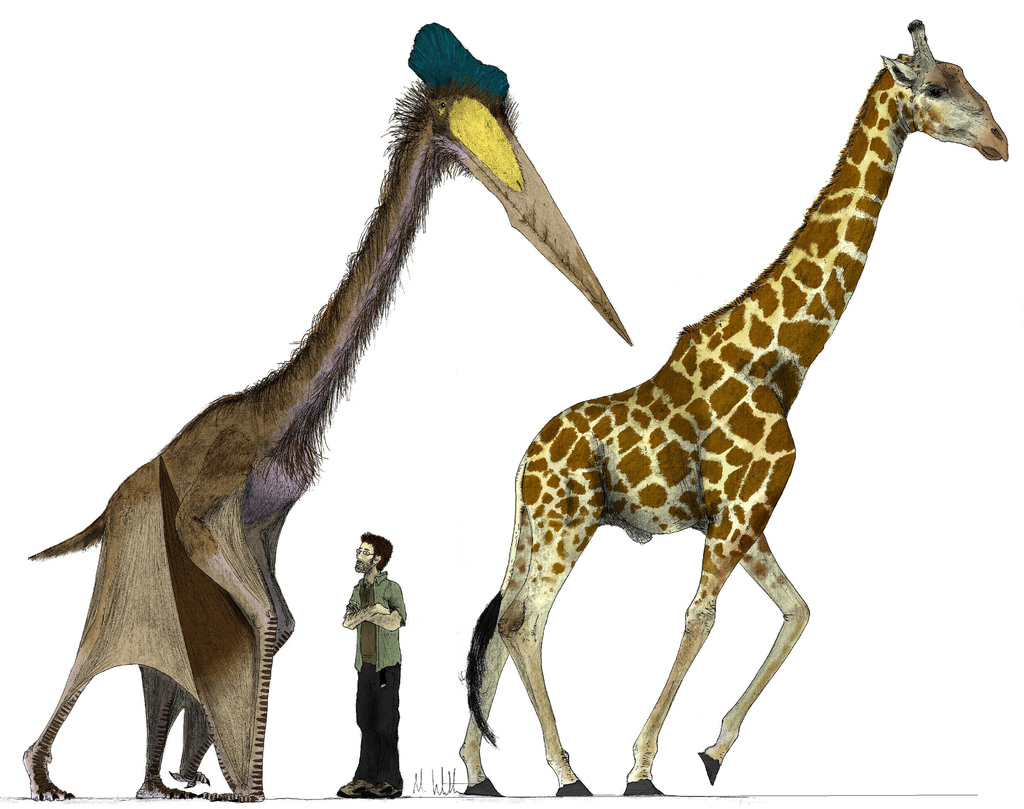
The giant pterosaur Hatzegopteryx compared to a modern giraffe. Illustration by Mark Witton.

The giant pterosaur Quetzalcoatlus northropi compared to a modern giraffe. Illustration by Mark Witton.

Excluding the giant Quetzalcoatlus for a moment, the other heaviest pterosaurs were Pteranodon at 41 pounds and Tupuxuara at 50 pounds. The estimates for the ancient fliers are not too far off the masses of the largest modern flying bird the Great Bustard, at 35 pounds. So, we know that it is at least possible for an animal of that weight to get airborne on a regular basis.

So, what about the giant Quetzalcoatlus? This animal is known from fragmentary remains from Texas where it was first found in 1971. While mostly known from fragmentary remains it is estimated that it had a wing span of 37 feet or more. Earlier estimates of the weight of this animal vary widely from 141 – 608 pounds. Henderson points out that many of the body mass estimates of the past were influenced by engineering constraints calculated for an animal with this great wing span to be able to fly. The thinking being that an animal evolved from flying animals most likely flew.

But, in an interesting twist, Henderson’s estimate is twice as much as previous estimates, so he turns the issue around and suggests the heresy that maybe giants like Quetzalcoatlus (and I would add Hatzegopteryx by extension) did not fly. Instead, it is perfectly reasonable to assume that a formerly flying species secondarily adapted to a fully terrestrial life style, growing to dramatic size as a protection from predation or for other similar advantage. We certainly can find examples of that in the modern birds too, in the flightless ratites, the emus and ostriches.

No doubt this issue will continue to be explored (for an alternative view see [link id=’2475′]) . That is the fun of science—keep probing and answers, and more questions, reveal themselves.

Henderson, D. M. 2010. Pterosaur body mass estimates from three-dimensional mathematical slicing. Journal of Vertebrate Paleontology 30(3):768-785.

Related Posts:
Formations
Niobrara Chalk
My National Geographic moment