Monthly Archives: November 2010

Purchasing Caravan Porch Awnings

When you are going camping, it is nice to have your own motorhome. This can be a lot of fun to take the entire family on a trip. You never know what the weather is going to be like on your trip. Sometimes it ends up raining and this is beyond your control. If you have motorhome awnings, you can save the day by still being able to enjoy the great outdoors on your trip.

Just imagine going outside and sitting under your caravan porch awnings. You will be able to relax and listen to the rain while enjoying your meal. Your lightweight caravan porch awnings will have saved the day. This is something that you want to purchase to add on to the current caravan that you already own. These are affordable and will need to be purchased after you originally buy your motorhome.

These are very affordable and a great add on for any camper. You can also use them to simply stay away from the bugs and wind. A lot of bugs can ruin the day especially if you have children along with you on the trip. The comfort of porch awnings will make your entire trip a lot more enjoyable. Do not put off buying this and then have your next vacation ruined by mother nature and things beyond your control.

Shop around and find the perfect caravan porch awnings for you. There are many different options available such as full awnings and smaller porch areas. You can even put a sleeping bag out here and enjoy the sounds of nature while you sleep. It is also perfect if you have a few extra people come along on the trip and they need somewhere to stay. Blow up a mattress for them and they are set for the night. Consider caravan porch awnings for your camping trips.

Related Posts:

[link id=’1810′]
[link id=’1762′]
[link id=’2039′]
[link id=’2231′]
[link id=’1273′]

Tips for Buying Your First Pair of Bird Watching Binoculars

If you are interested in bird watching and don’t have binoculars to help you out, you are definitely missing out on quite a bit. When you buy a quality pair of bird watching binoculars you no longer to squint trying to see what exactly you are looking at or climb up a tree to get the best view. You will be amazed at what binoculars can do for your hobby and they don’t have to cost a fortune.

Many people avoid buying binoculars because it can be confusing with all the different styles and models available. Some people also assume that a good bird watching binocular will cost you several hundred dollars but that is not true at all. The thing to remember when buying binoculars is that they all have two numbers which can tell you a lot about them. The first number is the power of the lens while the second is the field of vision or how much area you can see through the lens. So, for example, the Bushnell Falcon 10×50 would mean it has a power of 10 magnification and it has a 50 millimeter lens.

When looking to buy bird watching binoculars you need to keep a few things in mind such as how fast you focus on an object. Some of these products will have instant focus levers and buttons that make the job of focusing so much easier. You don’t want to miss seeing a bird flying away because you can’t focus your lenses properly.

Another thing to consider is the weight of the binoculars. If you like to bird watch for several hours at a time you don’t want to get a heavy pair that is gets too heavy for you to have around your neck or to even hold. Look for lightweight options so that you can use them for longer periods of time.

Lastly, realize that you may have to negotiate on some aspects of your binoculars. For example if you want a higher magnification to see birds up close and personal you may have to look for a pair that doesn’t have as wide of range. On the other hand if you want to have wide angle binoculars you have to remember that the magnification or power may not be as good as some of the higher priced models.

If you are still having trouble looking for a quality pair of bird watching binoculars that doesn’t cost you a fortune you may want to see if you can get a recommendation from other bird watchers. If you belong to a bird watching group, an outdoorsman group or some kind of bird watching forum online ask other people what model they are using. This is probably one of the best ways to find a pair that works well and will have you enjoying your hobby all day long.

What to call the giant cat from the Ice Age?

The Ice Age of the recent past was a fascinating time, full of superlative animals, especially the mammalian megafauna of North America. The Ice Age, also referred to as the Pleistocene epoch, lasted from 1.9 million years ago to 10,000 years ago, and was characterized by a series of glacial advances and retreats across much of the Northern Hemisphere. It was also a time of animal migrations between continents and of many species being exceptionally large.

Giant ground sloths, the giant short faced bear, saber-toothed cats, mammoths, and mastodons all tromped through what was to later become our backyards. Many people are surprised to learn that North America was also home to a very large cat, larger than the modern lion, given the scientific name Panthera atrox.

This big cat lived mostly across the western half of North America, and ranged into South America as far as Peru. Its remains are plentiful in the tar pits of Rancho La Brea. It is clear that this is a big animal. Estimates of body size suggest a weight of about 1,000 pounds, and that it stood 4 feet at the shoulder. For comparison, the modern African lion weighs in at about 375 pounds. This American cat would have been the second largest mammalian predator, right behind the giant short faced bear. (See How big was the Giant Short-faced bear?)

Panthera atrox

The giant American cat, Panthera atrox

However, understanding how this animal relates to other large cats has been difficult. Scientists have noticed similarities between P. atrox and the modern lion, tiger, and jaguar. For many years, P. atrox was thought to be a subspecies of the lion, and so it has popularly been called the American Lion, and even the American Cave Lion. If it is closely related to the African lion, it suggests that lions migrated out of Asia and into the New World during the Ice Age, expanding as far south as South America, and becoming extinct at the end of the age. Several other species are known to have done this, so that is not so unusual. But is it an accurate story?

In a recent paper on the subject (Christiansen and Harris 2009), researchers have come up with a different idea. They examined the skull and jaws of the big American cat and compared it with lions, tigers, and jaguars. They used a wide range of measurements to create a mathematical model of each species, and compared them to each other. The result? Panthera atrox does not seem to be a lion at all, but rather is closest to the modern jaguar.

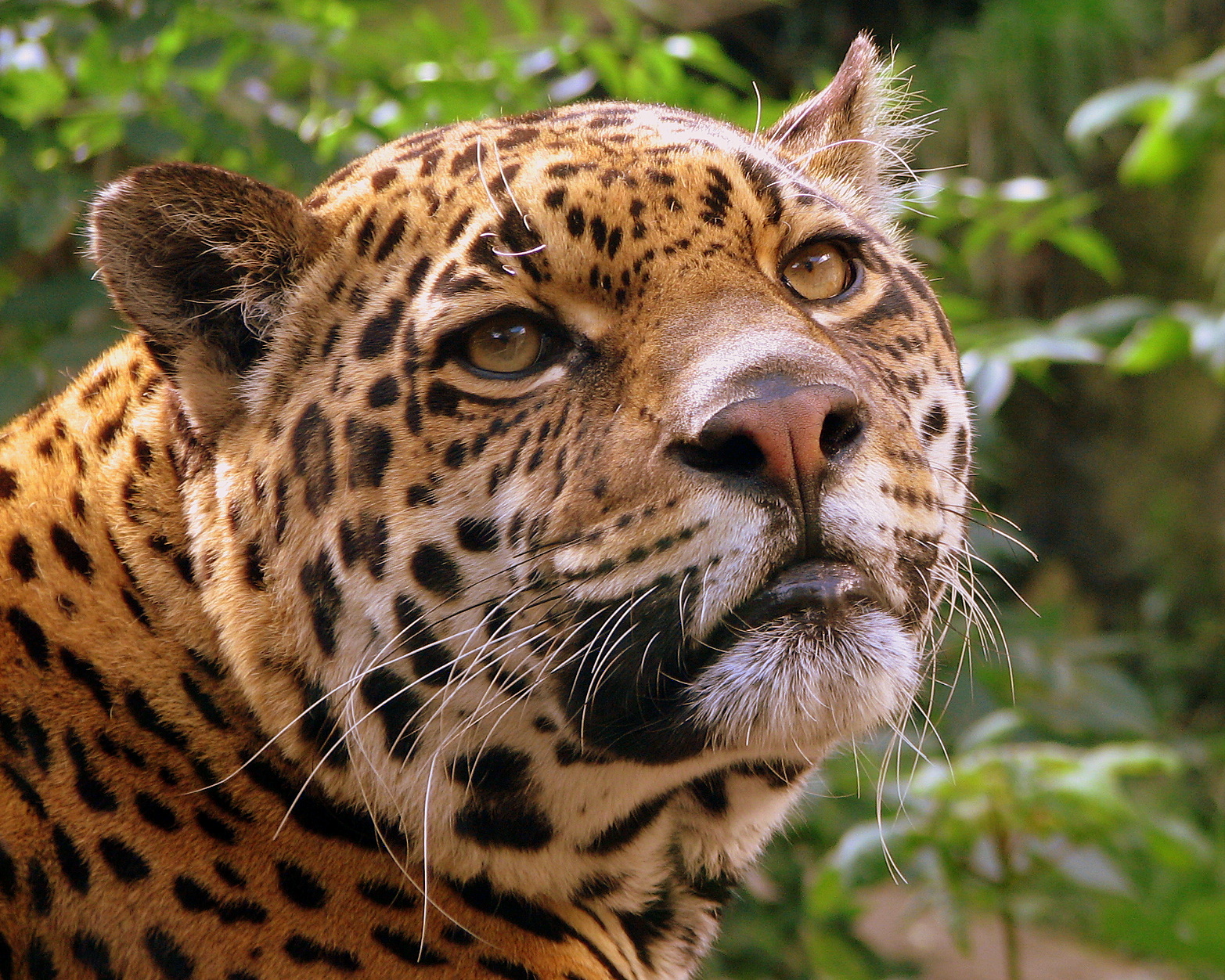
Jaguars came into the New World from Asia during the early Pleistocene. It seems then that P. atrox and the modern jaguar species, P. onca, are derived from the early jaguar that came into North America, and that lions never made that long trek across. If these researchers are correct, we should not call this magnificent cat the American Lion.

Jaguar at Edinburgh Zoo

A jaguar, Panthera onca. By Pascal Blachier from Savoie, France.

So, what should we call it? Jaguars are native to the New World, so the word “American” seems a bit redundant in the name. And the simple scale and grandeur of the cat requires some adjective. “Mega Jaguar” seems a bit plain to me. What do you suggest?

Christiansen, P. and Harris, J. M. 2009. Craniomandibular morphology and phylogenetic affinities of Panthera atrox: implications for the evolution and paleobiology of the lion lineage. Journal of Vertebrate Paleontology 29(3):934-945.

Mammoth protein designed to be cool

Researchers were recently able to isolate and study woolly mammoth hemoglobin and compare it to the modern African and Asian elephants. They isolated the genes from DNA that code for the creation of hemoglobin, the protein that carries oxygen in our blood. This was done for both the modern elephant species, as well as from DNA from mammoth bone from Siberia. They observed some minor differences between all the species, so the researchers wondered if the difference in the mammoth’s blood might have helped it survive in cold climates.

Hemoglobin supplies our body with oxygen by carrying it around in our blood stream and then releasing it to our tissues. When our tissues need more oxygen, like for muscles that are working hard, hemoglobin more easily releases oxygen because of the higher temperatures created by the heat generated by the muscle. However, in colder temperatures, hemoglobin does not give up oxygen as easily. This is potentially a real problem in colder climates. To keep the hemoglobin to working effectively an animal might need to expend valuable energy to maintain a higher body temperature.

The researchers (Campbell et al. 2010) wondered if the slight differences in woolly mammoth hemoglobin might have been an adaptation for living in colder temperatures. They inserted the Asian elephant genes that make hemoglobin into the common bacteria, Escherichia coli, and allowed the bacteria to act on the genes, thereby making Asian elephant hemoglobin. This process is not new as it is commonly used to have bacteria produce proteins that are identical to human-made proteins, like insulin.

To get the bacteria to make mammoth hemoglobin, they needed to modify the Asian elephant genes the same way they observed, then let the bacteria make the hemoglobin of a mammoth—thousands of years after the mammoths last did it themselves. Researchers could then compare the protein of the two species directly. The result was that mammoth hemoglobin released oxygen much more effectively at lower temperatures.

Woolly mammoths from Alan Turner (2004), National Geographic Prehistoric Mammals.

Woolly mammoths from Alan Turner (2004), National Geographic Prehistoric Mammals.

Woolly mammoths were adapted to colder climates in a number of ways, such as compact bodies, small ears, short tails, and long woolly hair. This result strongly suggests that their bodies were also changed at the molecular level for life in cold, high latitude climates during the Ice Age. It would be very interesting to see if other mammoth species, such as the Columbian mammoth, for example, shared this adaptation. But I suppose that will have to wait until we can get good DNA from that species. All in good time.

Campbell, K. L. et al. 2010. Substitutions in woolly mammoth hemoglobin confer biochemical properties adaptive for cold tolerance. Nature Genetics 42:536-540.

Related posts:
Science in dinosaur movies: Jurassic Park then and now

New cave art found in Romania

It is well known that humans in caves in Europe began painting scenes of animals and humans on cave walls over 30,000 years ago. Over 300 sites with cave art have been found, mostly in Western Europe in places such as Chauvet and Lascaux in France and Altamira in Spain.

This summer, a team of French researchers reported a new cave with art from Romania. This Central European site suggests that the prehistoric societies across Europe were linked by a common artistic culture.

A group of spelunkers were exploring Coliboaia Cave when they spotted the cave art. Some of the drawings can only be reached by using diving gear and navigating through very cold underground water-filled spaces.

The images of Coliboaia Cave include bison, a horse, two bear heads, and two rhinoceros heads. The style of the art is very similar to the styles known from western European caves.

Images of cave art in Coliboaia Cave, Romania

Images of cave art in Coliboaia Cave, Romania. Credit: Andrei Posmosanu/Romanian Federation of Speleology.

The best guess of the researchers currently is that the cave art is between 23,000 and 35,000 years old, but radiocarbon dates might help resolve the date. Plans are underway to conduct more thorough research on the site in the near future, but the remote location makes it challenging.

This post is a summary of this story.