In one post (New evidence on the size of pterosaurs) we explored the study by Henderson (2010) in which he modeled pterosaur body forms to generate estimates of body mass. He modeled different areas of the body separately, applying various densities to the different body sections to calculate his masses. His results suggested that the largest pterosaurs like Pteranodon (wing span of 17.5 feet) and Anhanguera (wingspan 13.5 feet) weighed about as much as the heaviest flying birds (41 and 14 pounds respectively). He reasoned that birds represent a reasonable analogy for flying limits in vertebrates, so this range of masses could represent the upper limit of being able to have powered flight in vertebrates.
His results for the giant pterosaur Quetzalcoatlus were astonishing. His calculations suggest that this animal weighed in at 1200 pounds, with a wingspan of almost 37 feet. After discussing various ways to interpret this result, Henderson suggested that maybe these truly giant animals did not fly at all, but were secondarily terrestrial. This evolutionary track can be found among the birds with giants like ostriches and emus growing large and losing the ability to fly.
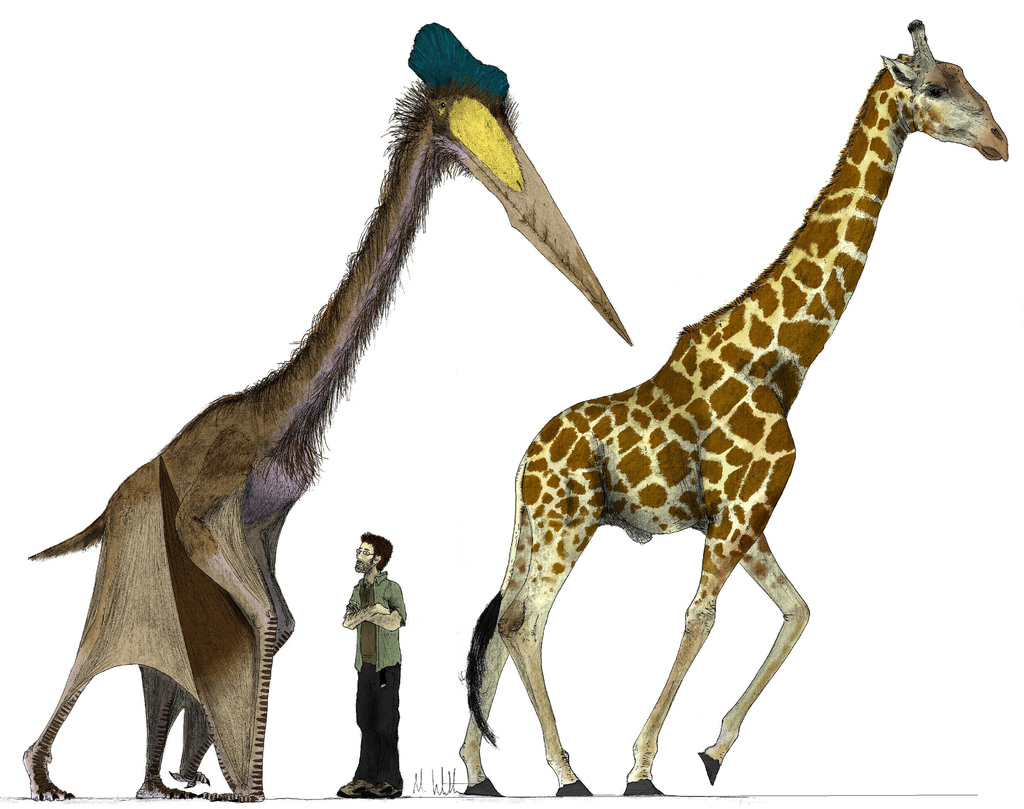
The giant pterosaur Quetzalcoatlus northropi compared to a modern giraffe. Illustration by Mark Witton.
Henderson’s work and conclusions was challenged by Witton and Habib (2010). Their criticisms involve several arguments. First, they suggest that birds may not be the best models for flight capacity, and that wing structure, overall anatomy, and launch mechanics were very different in pterosaurs. If so, then using birds as models for flight requirements and limitations in pterosaurs could significantly skew the results.
The heart of the arguments of Witton and Habib are the estimates of wingspan and mass suggested previously for pterosaurs. They note that relatively modest difference in wingspan calculations could have dramatic implications for calculations of mass. They state that mass estimates for a pterosaur with a 43 foot wingspan would be almost twice the estimate for a pterosaur with a 33 foot wingspan. Their assessment of the fossil material suggests that no pterosaurs had a wingspan of greater than 33-36 feet.
Likewise, Witton and Habib are critical of the body shape models used by Henderson for Quetzalcoatlus, arguing that his estimates of body size were too large, and were responsible for the very high mass values he obtained. Combined with Witton and Habib’s wingspan estimates, they calculate a body mass for Quetzalcoatlus of about 440 pounds, about one third the value of Henderson.
All of this discussion about wingspans and weights teases us with the question we really want to know—did the largest winged animals ever known actually fly? Could we have looked up into the Mesozoic skies and seen an animal flying overhead with a 34 foot wingspan and weighing as much as a tiger?
The problem, as is often the case in paleontology, is a lack of fossil material. The preserved material of these large pterosaurs is very fragmentary, and this significantly impacts our ability to accurately estimate their overall size and mass. We have in these two studies outlined here two extremes. We need more fossils before we can really know which study is most accurate.
Also, it is likely that birds may not be the best models for pterosaur flight as pointed out by Witton and Habib. Birds do things very differently than bats, our only other modern flying vertebrate, and it is most likely that pterosaurs had unexpected adaptations. For example, Habib (2008) is finding evidence for a vaulting launch in the largest pterosaurs.
Check out this video on the Quadrupedal launch in pterosaurs for an interesting viewpoint.
The largest pterosaurs have not been grounded quite yet.
References:
Habib, M.B., 2008. Comparative evidence for quadrupedal launch in pterosaurs. Zitteliana, B28: 159-166.
Henderson, D.M., 2010. Pterosaur body mass estimates from three-dimensional mathematical slicing. Journal of Vertebrate Paleontology, 30(3): 768-785.
Witton, M.P. and Habib, M.B., 2010. On the size and flight diversity of giant pterosaurs, the use of birds as pterosaur analogues and comments on pterosaur flightlessness. PloS One, 5(11): 1-18.