The character of living things on land changed forever after the Cretaceous-Tertiary extinctions, 65 million years ago. The dinosaurs on land and the marine reptiles in the oceans went extinct, leaving way for mammals and birds to evolve into those niches once held by the “terrible lizards” (dinosaurs) and other giant reptiles.
Throughout the Cenozoic, sometimes “mammal-centrically” referred to as the Age of Mammals, these warm-blooded, fur-covered creatures diversified into a wide range of beasts, including humans. While many of the land mammals got very large, they never matched the recording-holding dinosaurs for superlative size on land.
The largest animals ever known to have lived actually evolved after the dinosaurs and are in fact alive today. An ancient lineage of mammals returned to the oceans and evolved into the modern whales. (See the note about the largest animals feeding upon the smallest).
People are always excited about the Carnivores, or meat-eating mammals. There is something about the dangerous and frightening that excites our primitive nerve centers, so the carnivores are among the most popular at the zoo. (Technical note here—the word carnivore is used in two ways. Carnivore (with a capital “C”) can refer to the class of mammals, the Carnivora, most of whom, but not all, are carnivores (with a lower case “c”), meaning they eat meat. So, not all carnivores are Carnivores, and not all Carnivores are carnivores. Got it? Good.) (Also, see the series on Dangerous Animals for additional exciting facts.)
For example, I recall a visit to the Cincinnati Zoo, and while watching the famed white tigers my young daughter was thrilled when one watched her intently and kept pace with her on the ground while she ran giggling high above on the wooden walkway. She thought that it was a special treat to have one of these magnificent animals take a special interest in her. She felt less special when we mentioned to her that the tiger may not have had cuddling on its mind.
Elsewhere (see related posts below) we have discussed the Giant Short-faced bear (GSFB), Arctodus simus, the great bear from the Ice Age that lived across North America. The GSFB is the largest mammalian Carnivore known, but just how big was it?
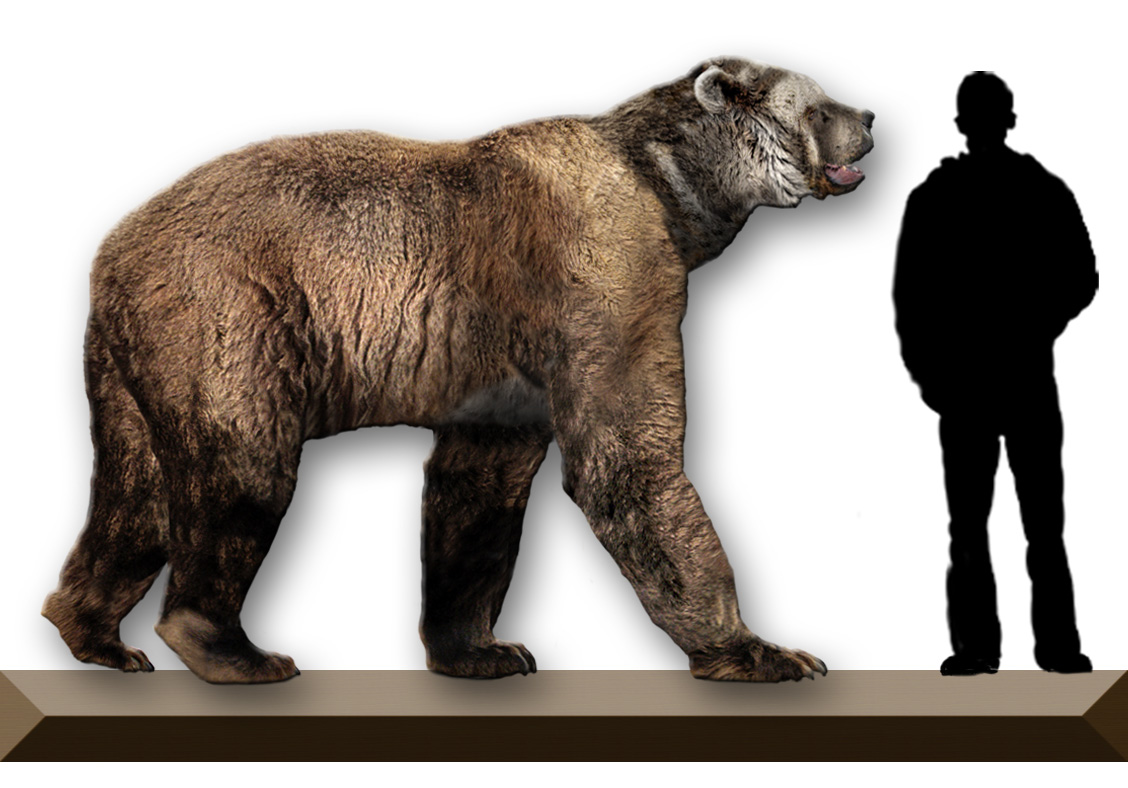
Recreation of the Giant Short-faced bear showing its size next to a human
Many people have examined this question, and one study lays it out clearly (Christiansen 1999). Christiansen examined both the GSFB and its European cousin, the Cave Bear (Ursus spelaeus), another bear famous for its dimensions. Several skeletal measurements have been shown to correlate to overall body mass in mammals. It makes sense that large species have bones of greater relative diameter than small species, and the relationship is more or less linear. By making these measurements a very good estimate of body mass can be made for extinct mammals.
Christiansen used many skeletal measurements of modern carnivores with known body mass to create his linear equations and then plugged in both species of bears to see what the formulas suggested. The results of this study are clear—the GSFB far outweighed any of the modern bears and the cave bear.
These data suggested that a typical (average) GSFB would have weighed in at about 1,700 pounds. Given that there are exceptional individuals, it is estimated that a really large specimen could easily have weighed more than 2,200 pounds. In contrast, the cave bear seems to have a mean body mass of about 1,000 pounds, with exceptional individuals approaching the average for the GSFB.
To further help put this in context, below is a list of select modern and extinct animals and their average body masses. I threw in a couple of dinosaurs for good measure:
Animal |
Body Mass (pounds) |
Blue Whale |
396,830 |
Brachiosaurus (extinct) |
62,300 |
T. rex (extinct) |
14,600 |
Giant Short-Faced Bear (extinct) |
1,700 |
Kodiak Bear |
1,090 |
North American Lion (extinct) |
1,000 |
Cave Bear (extinct) |
1,000 |
Polar Bear |
900 |
African Lion |
375 |
Indian Tiger |
320 |
American Black Bear |
230 |
Human |
160 |
Leopard |
115 |
Puma |
100 |
Velociraptor (extinct) |
98 |
Cheetah |
86 |
Gray Wolf |
78 |
Wolverine |
27 |
Red Fox |
12 |
No matter how you look at it, “Giant” is a good name for Arctodus!
Christiansen, P. 1999. What size were Arctodus simus and Ursus spelaeus (Carnivora: Ursidae)? Ann. Zool. Fennici 36(93-102).
Related posts: