Selecting the right hunting knife from the beginning will save you money, and likely some frustration. Spend a bit of time to learn about your options and select the features that are likely to best suit your needs before you buy one.
You should first ask yourself a number of questions. Like, what type of hunting will you do? Are you after moose or squirrels? Do you hunt game birds, or are you after white-tail deer and bear? Are you interested in cutting up game for meat or do you want to bag specimens for mounting?
Clearly, different sized and shaped knives will suite different needs better, and there is nothing worse than trying to gut or skin an animal with a knife that is out of proportion for the job. Using your Bowie knife to gut a squirrel is overkill to say the least, and skinning a bear with a short-bladed folding pocket knife is an exercise in frustration.
How often are you going to use the knife? Will you carry the knife when you are not hunting? Thinking about some of these issues up front will really help you in the end.
If you are going to be doing a lot of hunting, or want a strong knife, you most likely want to get a fixed-blade knife. This is the sort you keep in a sheath. The blade is fixed with the handle and it does not fold for storage. These knives are strong as the blade and handle are usually one continuous piece of steel with some material around the handle end for comfort. Being one piece, these knives can take more torque and abuse than a folding knife. With a folding knife, the blade is hinged to fold, and the pivot point is an inherent weak spot for the knife.

Many different blade shapes are available in hunting and pocket knives.
There are many styles of blade shape too. The ends can be gently or dramatically curved, with the point of the knife more or less defined. A knife with a rounded tip is often better for skinning as it is less likely to stab through the hide or meat. Dedicated skinning knives have short, blunt blades with a sweeping cutting edge. They are not very long, so you can control the tip of the knife well.
Some hunting knives have a gut hook. This is a notch on the backside of the blade designed to puncture skin and make a shallow cut. When you are working to eviscerating an animal you want to avoid cutting into the gut contents and having that spill out over your meat. The gut hook helps prevent you from accidentally doing this by cutting just through the skin and muscle layer of the abdominal cavity, allowing you to remove the guts cleanly. This feature might be worth it to you if you are gutting larger animals like deer.
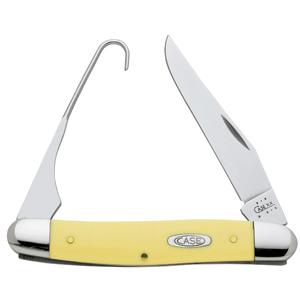
Pocket knife with a bird hook.
If you hunt upland birds, like pheasants, you might want to consider a bird hook. The hook is used to insert into the body cavity, swirl it around, and pull out all the viscera in one smooth action.
Remember, you do not have to spend a lot of money on a knife for it to suite your needs well. Even utility knives from the hardware store can be very serviceable in the field, cutting and preparing game. I would also recommend that you not get a knife that is too large. Avoid the “Crocodile Dundee” temptation of getting a huge knife—you don’t really want to carry that heavy thing around and it is too big for most tasks anyway.
Handle material is often a personal choice. You can get wood, leather, bone, antler, and various plastics on your knife. Some people really like the natural look, but for utility and strength, plastic is a good choice. It is strong and easy to clean. You can soak it to get blood and other “junk” off of it, and not worry about it being damaged in the water. Plus, it may be less likely to pick up “gamy” smells from use.
There are many considerations and I hope this helps you to think about them before you sink a lot of money into this useful tool.

Skinning a road-kill Black Bear to recover its pelt and skeletal elements.