Monthly Archives: June 2010

The Insulating Benefits of a Sleeping Bag Liner

As a necessary requirement for any camping activity or outdoor overnight activity, the sleeping bag is very important. When sleeping in the cold outdoors, it is vital that the proper type of bag is purchased. All products provide a rating on the label, so you know how much protection you will have against the cold. For bags that do not provide enough warmth in the cold, there are other options in improving performance, without purchasing another bag. A sleeping bag liner or travel sheet slips inside your bag, to improve its ability to protect you from the cold. Liners can be added or removed to meet the changing requirements from one day to the next or in different locations.  These products typically come with a zipper, which aids in keeping warmth in your bed roll.

One product available is the silk liner, which is desirable because it is soft, yet sturdy. Other products combine Egyptian cotton with silk, for an even more comfortable feel. Silk fabric is a soft and shiny when dry, yet becomes very strong when it gets wet. Woven silk provides insulation properties that are far better than other heavier fabrics. This makes it perfect for use with bedding, particularly in the outdoors. It can greatly improve the comfort level of the sleeping bag and allow the user to get a better night’s rest. Silk used to make consumer products interestingly comes from caterpillars. If you think about how well this creature’s cocoon keeps out chilling temperatures, you can understand the benefits that using silk will provide in keeping you warm.

If the high cost of a silk liner is not in your budget, you can buy a fleece liner as an alternative. Fleece is made of natural animal fibers, typically from the yak or sheep. It keeps animals warm, so it will help keep you warm inside your bedroll as well. Liners made of this fabric can be washed in a machine at home and are available in many bright colors as well. Coleman offers a desirable product which folds into a highly compact roll, which is kept in place with a stretch cord. This can keep you warm in temperatures as low as fifty degrees (F), by itself. This is an indication of just how warm you will be when using this product inside your bag. It is a very thin fabric, but provides quite a bit of warmth.

As weather conditions can change very quickly outdoors and wind chill can make the environment much colder, using a bag liner is the best way to ensure you will stay warm, when such conditions arise. Many have additional handy features, like a carrying pouch or a closable storage pocket. These items are easy to pack and take with your other camping gear.

Illinois Pocket Watch History

In a grand building standing on many acres, the Illinois Springfield Watch Company was born. The year was 1869. The man: J.C. Adams. Adams founded the company based on industry and a vision for the future. Springfield was a booming town and Adams, among others felt it was the perfect place for pocket watch manufacturing.

The first company directors included J. T. Stuart, once a partner of Abe Lincoln, a bank president named Williams, a local merchant named Miller and others. The Illinois Springfield Watch Company began production in 1872, however, things were not in full swing until around 1875. They initially produced key-wound watches and later, a line of fine railroad pocket watches as well.

The company reorganized twice, due in part to financial issues. By 1885, they had become the Illinois Watch Company. The company produced many a pocket watch, not all under the Illinois label. They brought us names like Burlington, Santa Fe, Plymouth and Washington, all produced by Illinois but sold by different means and various exclusive retailers.

The last pocket watch in the Illinois tradition was made in 1932. the Hamilton pocket watch company had purchased the Illinois Watch company in 1927, continuing to manufacture true Illinois. However, after 1932, Hamilton was producing watches with the Illinois label that were technically Hamilton pocket watches.

Just because the Illinois pocket watch ceased production in 1932 does not mean a collector can not still find them today. There are many classic Illinois pocket watches in excellent condition available for sale. Antique dealers, pocket watch guide websites and even ebay are great places to find them. As any collector knows, don’t expect them to come cheap, as antiques never do. The purchase price is going to be dependent on the pocket watch condition, model and year of production (age). The most important any collector or buyer should ensure is that the watch they are buying is authentic. Ask for proof. Any reputable pocket watch seller will be more than happy to meet this request.

Sitting by the Fire in the Log Cabin and Watching the River Flow By

When ever you read about nature and its bounty, you heart and mind race to relive those moments of the past when you spent hours out in the open communing with nature.

The urban city lifestyle throws us into an entirely different orbit altogether. Before long we realize that our lives have changed, meetings, schedules occupy and direct our time and attention. Family relationships have changed and all have moved away to far away cities only to be heard over the telephone once a week. Does this sound familiar? Well, while it may be true, you do not need to panic and feel that all is lost.  Though one cannot go back to the same old easy living style that you grew up with, nothing stops you from re creating the same magic.

Connecting back with nature, spending time in a huge cottage or log cabin with all of the loved ones for over a week and enjoying simple joys of life can help you re build your inner reserves and give you the sense of peace, joy and fulfillment that your heart years for. The long lost love of nature can be found once again. UK National Tourist Board is actively helping the premier cottage and properties to offer the best facilities to the tourist for short term and long term stays.

The way to plan your holiday for entire family is easy. Web sites give you detailed tour of location, property, facilities and all of the required details. You can choose the location specifically either in England, Wales, Scotland, Channel Island or Ireland as you wish.  Depending upon the family members you can choose self catering cottages, log cabins, holiday cottages, lodges, barn apartments or houses.  The list of available properties is impressive. You can choose from 145 properties in Devon to over 75 holiday homes in Peak District & Derbyshire. If you plan in advance, you would be able to get a good discount over the price offered.  The owners most often stay close to the properties or often on-site and spare no efforts in making you feel at home. The Log Cabin Holidays Directory is a great place to start looking if you want to find a special log cabin in the UK.

You can choose the best site depending upon your preference of wanting to be close to a forest, river, mountains etc.  One can choose the setting and the theme to celebrate an occasion and hold a family re union or get together. Luxury homes provide the perfect environment for entire family to relax and enjoy and come equipped with swimming pool, house complete with all kitchen equipments, accessories, well fitted bathrooms, appropriate LED lighting and all modern luxuries coupled with privacy and bountiful nature thrown in for added value.  Once you have taken a holiday in the holiday home, it is guaranteed that taking vacation will become your habit and there will be many more occasions for family reunions.

Advice on Installing Travertine Tiles

Tiles come in a wide variety of materials. No matter what material is chosen, installation has these basic steps. One of the first requirements is a solid and firm base. A mastic or mud bed is spread on the firm base to hold the tile in place. The tiles are then laid on the mud to form the desired pattern. The mud is allowed to dry before a grout is spread to fill the spaces between the tiles. A sealer is applied to the entire area to prevent discoloration of the grout and the tile.
The above statements apply to all forms of tiles. Installing travertine follows the regular rules plus a few that are specific to a natural stone and a veined material.

One of the considerations when working with travertine tile is the veining of the stone. A commonly used method of shaping man-made tiles is by using a “score and snap device”. This method does not work with travertine. The natural travertine is porous, and may have those pores filled with a special mixture of cement and epoxy. The combination of the stone and filler gives the tile an irregular density that requires a power tool to cut the tile. The veins that run through the travertine add another complication for the installer. The veins are a natural “weakness” lines in the stone. Cuts can be made across the veins, but experience working with travertine will help guide a installer to prevent unwanted breaks both at the time of setting and later.

Black Rock travertine

Black Rock travertine

The tiles are cut from natural stone. The stone will vary from quarry to quarry and cutting results in some irregularities in the thickness and shape of the tiles. Most of the irregularities can be adjusted by the way the tile is laid. Again, an experienced tile setter will adjust the mud bed to compensate for variation in thickness, and can position the tiles to conceal the size differences.

Because the stone is a natural product and no two tiles will be the same, the coloration in the stone will vary a great deal. Some of the tiles will have many veins and others little or none. It is highly recommended that you open and inspect all the boxes of tiles to allow the installer and the homeowner to view the stone and lay out a pattern that is most pleasing. This will also allow the installer to select the best tiles to cut before the job is started. This could save time and money because fewer tiles are ruined. In many cases laying out the whole area will be well worth the time.

Most installers feel that sealing the tile is a must. Sealing the stone is a simple way to assure the tile will remain beautiful. Re-sealing the tile every few years is also recommended. The routine care and maintenance is best done with clear water.

Mild soaps can be used but harsh cleaners and acids should never be used. The calcium carbonate of the travertine will react with even weak acids and dissolve. This will cause the stone to etch and could cause significant and irreversible damage. If you are uncertain you can test any cleaner on a sample tile reserved for that purpose before you use anything on the installed tiles.

Related posts:
Introduction to Travertine Tiles
Unusual Occurrence of a Fossil in Travertine

My National Geographic moment

“A photographer from National Geographic wants to talk to you.” These words, or words to those effect, met me as I came into the museum office one day back in 2001, and they definitely caught my attention.

It was 2001 and I was Assistant Director of the Sternberg Museum of Natural History. We had just reopened the museum in its new location in Hays, Kansas, a few years before in 1999. The museum had enjoyed some tremendous success at attracting visitors and media attention from across the state. And now someone from National Geographic wanted to talk to us? Wow. I returned Jonathan Blair’s call and began an unusual week of activity.

It turns out that the magazine was going to run a story on pterosaurs, the flying reptiles from the Mesozoic, and they hired Jonathan to get pictures to illustrate it. He had already traveled to some of the great museum collections for pterosaurs in Europe and the United States, but he wanted to visit Sternberg. The Sternberg’s collection of pterosaur material is about the third or fourth largest in the nation, and very significant.

The Sternberg Museum, on the campus of Fort Hays State University, was managed for many years by George F. Sternberg, famed fossil collector. He spent his free time out in the chalk, the Niobrara Formation of western Kansas, collecting the fish and swimming and flying reptiles that left their remains millions of years ago. Sternberg supplemented his salary at the museum by selling specimens to other museums, but if he collected something really nice it went into “his” museum. Over the years, the museum’s collection grew in size and quality.

Besides our amazing collection of fossils, Jonathan had heard about our life-sized pterosaur models we had just installed in our walk-through Cretaceous exhibit. And he had a crazy idea—let’s take a life model of the beast and “fly” it over the very rocks where its remains can be found. He wanted to take one of our life-sized model and photograph it over the chalk beds.

Well, I can bend over backwards for National Geographic, but taking one of our brand new models down from the ceiling, which had not been easy to install in the first place, and which since had walls built up around them, and truck them 70 miles to hang from a crane in the chalk sounded a bit risky to me.

But I did offer to help in any way we could, so I did the next best thing—I found him another pterosaur model.

Over the next several days we made plans and preparations for the big event. We needed to get the model that I was able to find shipped to the museum. It had been kept in storage and was a little beaten up, but the company that supplied it sent a staff member to clean, fix it, and touch up the paint for its big moment. The model, being life-sized, had a twenty foot wing span, flimsy neck with a large head at the end, and feet that stuck out the back, giving the whole thing a cross shape, making it too long in any direction. Not exactly the easiest thing to get into a truck and ship!

We scouted a location for the big photo shoot. I took Jonathan to the Castle Rock area, a well-known outcropping of the chalk that has easy access and grand vistas. We needed to secure special permission as we were going to bring in a crane and another truck to transport the pterosaur model.

We needed to arrange for a crane to make the 70 mile one-way trip from Hays to the chalk beds. On this, and on so many other occasions, I marveled at the “can do” spirit of western Kansas people. You want something done just ask a former farm kid. While he might look at you funny, he will get it done.

In between all this activity, I remember some spectacular meals shared with Jonathan, listening to his many adventures from around the world while taking photographs. He also shot pictures around the museum, and he took a couple of photos of me that I have cherished ever since.
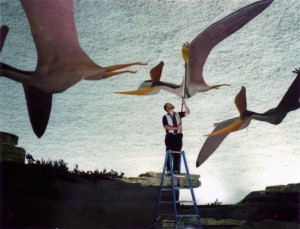
Greg dusts the life-sized models of Pteranodon sternbergii in the Sternberg Museum of Natural History

Greg dusts the life-sized models of Pteranodon sternbergii at the Sternberg Museum of Natural History. Photograph by Jonathan Blair.

The big day arrived and all was going well. The weather cooperated, the truck was loaded with its ungainly cargo, and the crane made it to the site. We had also brought along a number of crew members to help hold the model. We wanted to lift it into the air for the photograph, but if you know anything about western Kansas, you know it is windy. I was not sure what would happen when you lifted such a thing into the gusty winds, and how hard it might be to control. The only control we had were guy-wires coming down from the wing tips to hold it against unruly behavior.

With trepidation we gave the signal to the crane operator to lift, and the hundred pound model took to the air. And in the end, the wind was no issue—the model, like the animal it represented, was built for the air. It found a comfortable equilibrium and settled into the wind easily. Jonathan snapped his pictures, and just like that we had what he had come after.
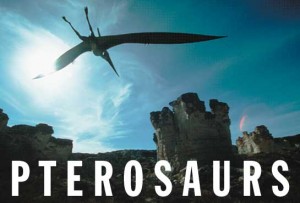
Life-sized model of a pterosaur, an ancient flying reptile, soars onces again over western Kansas

Life-sized model of a pterosaur, an ancient flying reptile, soars once again over western Kansas

We took more photos at a few other locations, all of which could have made fantastic desktop images, but he knew he was done. We packed up and came home, and all those days preparation resulted in the lead image for the story. It was all Jonathan’s photo and idea, and I enjoyed the part I played in making it happen—one of the perks for working at a museum.

See the National Geographic story.

Jonathan Blair’s web page

Related Posts
Geologic Formations