Monthly Archives: July 2010

Mountain Lions

They go by many names: puma, mountain lion, mountain cat, catamount, and panther, and scientifically as Puma concolor. The mountain lion is presently North America’s second largest cat, with the jaguar (Panthera onca) being the largest.

Mountain lions are widely distributed, from the Yukon Territory in Canada south through the western states, through Mexico and to the tip of South America, giving it one of the widest distributions of any species in the New World. There is a second population center in Florida, a relic population from when the species was spread coast to coast during the Ice Age. Recently, there is evidence that they are pushing their way onto the Great Plains states from the west, with reports of sightings as far east as Kansas.

They are large predators, with males weighing approximately 140 pounds, and females 90. They are considered the largest of the small cats. What?

Cats have been divided into two subfamilies, with the big cats being tigers, lions, leopards, and jaguars. The small cat subfamily includes the smaller cats like lynx and a host of species like jungle and mountain cats, marbled cat, and ocelot. The small cats also include your house cat.

Like all cats, the mountain lion is carnivorous and eats meat exclusively. They will eat anything they can catch, from insects to large animals like deer, and very occasionally elk and moose. They also are known to kill domestic livestock including cattle, horses, and sheep. It is this that caused the cats to almost be exterminated, but with legal protection their numbers are making a comeback.

The mountain lion, Puma concolor. Photograph by Bas Lammers.

The mountain lion, Puma concolor. Photograph by Bas Lammers.

This post is another in the dangerous animals series where we are exploring animals of North America that could be considered a threat to humans. However, like all the other animals, the threat is very small. Mountain lions have been known to attack and kill people, but it is a rare occurrence. Humans are increasingly moving into remote areas that host  mountain lions, and encounters are increasingly likely, but mostly encounters involve seeing the tail-end of the cat disappearing.

Attacks are rare because unless they are threatened or cornered, attacks are brought about as the cat is hunting for prey, and since they are not habituated to seeing humans as prey, they avoid people. Many who are attacked are smaller in stature, such as children or women, and victims are often jogging or engaged in a similar activity that might trigger the pursuit instinct in the cat when they are very hungry.

Mountain lion foot print

Mountain lion foot print at a dinosaur dig in Colorado.

It is for this reason that it is recommended that if you encounter a mountain lion you should make yourself look less like prey and more like a handful. Standing up large, waving your arms, shouting, and such things will discourage the cat from attacking. Do not run.

Between 1890 and 2005 there were 88 attacks on people, and 20 fatalities (Arizona Game and Fish 2010), so on average there are a few attacks, and fewer than a single death, each year. As far as risks that we live with everyday this is really is not much of a danger.

Average number of deaths per year caused by various animals

Average number of deaths per year caused by various animals

I have been fortunate to have seen a glimpse of one of these great beasts in the wild, and if you are so lucky, cherish the moment.

Arizona Game and Fish. 2010. Confirmed mountain lion attacks in the United States and Canada 1890 – present. http://www.azgfd.gov/w_c/mtn_lion_attacks.shtml.

Shark bites in the Cretaceous Sea

One of the most exciting things in paleontology is being able to definitively establish the interaction of two species from the fossil record. It is thrilling to picture a moment in time, millions of years ago, when two animals were at the same place, at the same time, and be able from fossil evidence to glean something about their interaction and behavior.

One dramatic example of this is finding a fossil with clear evidence that it was bitten by a shark. During the Late Cretaceous, North America was cut in half by an interior sea that extended the Gulf of Mexico across the mid-continent to connect with the Arctic Ocean in the north, effectively creating two land masses where today there is one.

In this last period from the Age of Dinosaurs, fantastic and strange creatures swam the seas. Today, the sediments from that ocean are exposed in badlands across much of western Kansas, Nebraska, and South Dakota. These geologic formations, like the Niobrara Formation, preserve a rich record of the ocean life, and clearly show what a scary ocean it was.

Tylosaurus model from the Carnegie Collection

Tylosaurus model from the Carnegie Collection

Giant marine lizards thrived in the sea. These beasts, close relatives of modern snakes and lizards, were called mosasaurs. There were several kinds that likely had different modes of life, some making use of resources close to the surface, and other species specializing in deep-water feeding, with the largest of them reaching 50 feet in length. They were joined by another group of marine reptiles called plesiosaurs. Plesiosaurs occur in two basic body plans, with the unimaginative names of long-necked and short-necked for obvious reasons.

Long-necked plesiosaur Styxosaurus

Long-necked plesiosaur Styxosaurus

The long-necked plesiosaurs have been described as looking like a turtle with a snake threaded through its shell. They had a stocky, turtle-like body, enormously long necks capped by a remarkably small head, and stumpy tails. They had four large flippers that helped to propel them through the water as well.

Short-necked plesiosaurs had large heads attached to short, thick necks. The long-necked forms most likely specialized in eating smaller fish with their small heads, maybe using their long necks to “snake” their way amongst their prey before being noticed. The short-necked forms obviously ate large prey, as evidenced by their massive heads and powerful jaws. (You can find models of both long and short-necked forms, as well as mosasaurs as part of the collection of dinosaur toys).

Living alongside these giants of the sea were animals that we would easily recognize, at least for their general body plan—these were the sharks. There was a significant amount of shark diversity in the Interior Sea as well, from relatively small forms that likely ate near the sea floor, to mid-sized forms that ate smaller fish and scavenged on dead carcasses, to several very large species that rivaled the modern great white shark in size and ferocity.

On occasion, when finding remains of fish or the marine reptiles, we find evidence of those remains having been bitten by sharks. The most compelling evidence is when teeth are found embedded in the fossil remains, but also punctures and tooth scratches can be a telltale sign.

Several plesiosaurs have been found as partial skeletons, with bites in several areas of their body, suggesting that after they died and settled to the ocean floor their carcass was scavenged by mid-sized sharks.

Cretoxyrhina bites the back of a mosasaur in the Late Cretaceous

Cretoxyrhina bites the back of a mosasaur in the Late Cretaceous. Painting by Dan Varner.

And in one dramatic example, the great white of the Kansas seas bite the back of a mosasaurs, cutting a section of vertebrae completely out of the giant lizard. The section of back, with its included vertebrae, was later spit out by the shark after having been mostly digested. The gristly remains settled to the ocean floor to lie there for millions of years before being found and placed in a museum.

Today we are fascinated by tales of shark attack, with the movie Jaws being a prime example. You can learn about these dangerous animals in another post, but perhaps it gives you some comfort to know that the denizens of the ancient seas also were subject to shark bites!

Additional information about this specimen can be found at Oceans of Kansas.

Choosing Garden Netting For Pests

After all the careful preparation in the spring and months of tending to your young garden, the last thing you want is to be overrun by pests before you can enjoy the harvest from your efforts. Whether it is insects, rodents, small animals, deer, or birds, the chances are that you would prefer to keep them from your vegetables and fruits in the garden. And while there are a number of good alternatives for keeping these uninvited guests out of your plants, one of the most effective is garden netting for birds.

Specialized netting can be used for a surprising number of applications in the garden. Not only can it be utilized to provide shade to your plants or support to your vines, but it is quite effective in keeping unwanted visitors from eating your crops. For whatever reason, most people tend to hesitate when it comes to applying garden netting in their own gardens.

A common problem for home gardeners is keeping birds out of their fruit trees and berry bushes. Bird netting is an excellent way to protect these fruits from the birds. Simply find a netting style that meets your expectations, drape the netting over the plant, and enjoy your crop when you want to enjoy it. The netting effectively keeps the birds from your crop, and can integrate quite seamlessly into the flow of your garden design.

For many of the insect problems that the average gardener faces, a combination of natural sprays and garden netting is often sufficient to keep these critters away. For your plants that will allow a protective layer of netting, draping the nets over the plants is quite effective in keeping larger bugs from infiltrating your plants.

Whatever your pest problem, there is likely a netting that will help to protect your garden. If you find yourself faced with pests, don’t be afraid to take action. You’ve worked hard on your garden, take the time to protect what you have created.

A Rainbow of Jade Stone Color

Jade, a name which is used for both the minerals nephrite and jadeite, is a stone which can be extremely valuable. This stone can vary in hardness from 6 to a 7 on the Mohs scale and can have a wide variety of colors depending on the type of stone and content of foreign minerals contained within it.

Nephrite jade, the softer of the two jades, is actually the toughest of both. It measures a 6-6.5 on the Mohs scale but due to its tough, interlocking crystalline structure, is much tougher to break. It is said to come in less colors than jadeite, yet has a very large range (not just the stereotypical green which comes to mind when people think of jade as a color).

Jadeite is the harder of the two jades, and measures a 6.5-7 on the Mohs scale. This stone is more valuable due to its rarity. It only comes out of Burma in commercial amounts while nephrite is found all over the world (though produced in commercial amounts in British Columbia).

The colors of jade vary depending on its mineral composition. When there is a content of iron present in jade it can appear red, orange or yellow. When graphite and iron are present the jade can appear black. When chromium is present the color of the jade stone can appear green. When there is no foreign mineral content, and therefor just pure jade, the jade stone will appear white.

The color of the piece of jade can affect its price. Today, green jade is considered much more valuable. In the past it was white jade which was the most valuable to the Chinese due to its purity.

Though jade can appear in green, blue, white, red, black, orange, yellow or violet (just to name a few of the colors) the shades of each color can vary enormously. Due to this fact the price of jade is also determined on how vivid and striking the color actually is. Value is not only determined by the jade stone color but also by its translucency, depth and if any fractures are present.

Venomous Snakes of North America

This is the latest post in the Dangerous Animals series. Snakes cause some people to have a physical reaction of fear and revulsion, which is too bad as they are fascinating creatures. In many years as an educator about the natural world, I loved to use live snakes as examples. Many species can be safely handled and brought out with the public. They always create a stir among the viewers, some right up front with wide-eyed excitement, and others trying to appear casual while they move to the back of the crowd to let others get a good view.

I always respected the feelings of those folks who felt a bit uncomfortable, and ironically it was often the big, burly, macho males of the group for whatever reason. Numerous times in such situations I watched as the boy in class with great fear at first watched others touch the snake, with comments like “Oh, it is not slimy,” or “Wow, it feels cool,” and then slowly make his way to the front. It was always a great personal triumph when he screwed up his courage enough to tentatively reach out a finger to touch the snake and overcome some of his own demons.

As an aside, it also always upset me when I would see one spouse, usually the man, use one of the very realistic snake models we had to sneak up on his wife and scare her with it. That is not helping at all.

I think such fear is caused by a lack of understanding about these amazing creatures, and the knowledge that some of them are dangerous animals. That combination leads to lots of misinformation and confusion. The vast majority of snakes are harmless to humans, and all of them serve an important role in their ecosystems, being predators on small species helping to keep their numbers in check.

The venomous snakes of North America fall into two families: the vipers and the elapids. The vipers, more specifically pit vipers, include the copperhead (Agkistrodon contortrix), the cottonmouth (Agkistrodon piscivorus), and the rattlesnakes (about 30 species in the genera Crotalus and Sistrurus). The pit is a special heat-sensing organ located on either side of the head, between the eye and nostril, which allows the animal to track changes in temperature in its environment. This is most useful for tracking warm-blooded prey such as small rats at night, without needing light. In experiments, the snakes can be deprived of vision and a sense of small, and still stalk prey and strike with great accuracy.
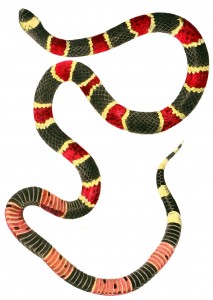
Eastern Coral Snake

Eastern Coral Snake

The second group of venomous snakes belongs to the family Elapidae, the family that includes many deadly snakes such as cobras, sea snakes, and kraits. The coral snakes (Micrurus and Micruroides) are the New World representatives of this family. They live in three areas across the south. The eastern coral snakes lives in the Carolinas south to Florida. The Texas coral snake lives in Texas and Louisiana, and the Arizona coral snake lives in Arizona and extreme southern New Mexico. They are reclusive snakes, mostly living underground, are nonaggressive, and account for very few snakebites each year, which is a good thing because their venom is a very potent neurotoxin. Read more about venom here.

The copperhead is one of the most beautiful snakes in my opinion. They live in the eastern woodlands of North America, being found from Kansas and Oklahoma east through the southern and New England states.
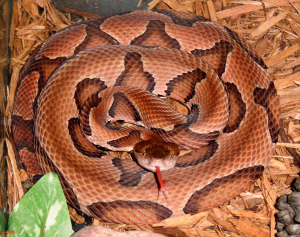
copperhead

A copperhead snake, Agkistrodon contortrix, perhaps one of the most beautiful snakes in North America.

It can be found in northern Mexico in desert areas, but is closely associated with semipermanent water sources and riparian areas. It is a docile snake, and mostly relies on its coloration to keep it hidden. I have known hikers to step right over the snake without ever seeing it or having the snake react, which can also lead to bites when it gets stepped on directly. The venom of the copperhead is less toxic than the other pit vipers, and bites are generally less severe than from other venomous snakes.

There is a great deal of worry about the cottonmouth in the area that I grew up in, Ohio, which is ironic since they do not occur there. (I have observed this phenomenon over and over, with people being deathly afraid of species, having heard from so and so some horrific story about it, and just sure that they are of great concern when it does not even occur in the area. Humph.) They do occur across the southeast states, from extreme southern Virginia through Florida, and west to Oklahoma and central Texas.
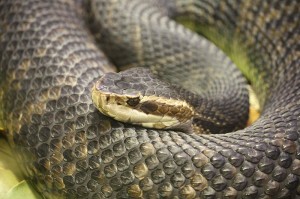
Cottonmouth

Cottonmouth

The cottonmouth is closely related to the copperhead, but its temperament is not as docile. One of the reasons that this snake causes fear I think is because it can be hard to identify in the field if you are already predisposed to fear snakes. It is a heavy-bodied snake that is generally dark olive in color and resembles several species of harmless water snake. When threatened, the snake may open its mouth wide, flashing the white interior of its mouth as a warning, giving it the name cottonmouth. Its resemblance with several species of harmless snakes gives rise to far more “encounters” with cottonmouths being reported than actually occurs.

The rattlesnakes are a diverse group of snakes that only occur in the New World, and a species of rattlesnake occurs in every state in the contiguous United States expect for Maine. They do not live in Alaska or Hawaii. The largest native snake in North America is the eastern diamondback, which can reach over 7 feet long, although that is rare. (The indigo snake can be longer, but the eastern diamondback is heavier bodied.)
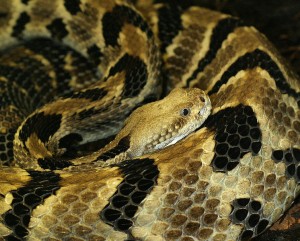
Timber Rattlesnake

Timber Rattlesnake

Their most obvious physical trait of rattlesnakes is the presence of the rattle, which is a modified string of scales on the end of the tail. The scales interlock in such a way as to allow the snake to shake its tail vigorously and cause the scales to rattle, giving notice to animals around it that it is there. As a warning system, it likely evolved so the snake could let large ungulates, that move in big herds, know that the snake was there specifically to avoid being stepped on. The snake most definitely would like to be left alone so it does NOT have to bite to defend itself. Listen to a rattlesnake here

Rattlesnakes would mostly like to avoid confrontations with humans too. When disturbed it will make its presence known and try to make a retreat. Some species are more likely than others to stand their ground and not flee. Bites most often occur when people fail to leave the snake alone, or surprise the snake unexpectedly, such as reaching under a log or into a rock crevice.

Venomous snakes do cause just over 5 deaths per year in North America (Langley 2005), and more bites that do not cause death, but injury and pain. (See this post for information about the number of bites each year). However, that number of fatalities and injuries caused by snakes pale in comparison with automobile deaths nationwide, with over 37,000 occurring in 2008. But automobiles are part of our everyday experience, which engenders a more blasé attitude generally than snake encounters.
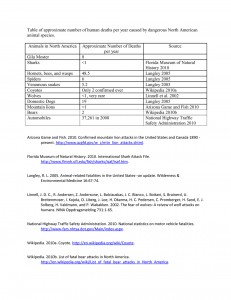
Average number of deaths per year caused by various animals

Average number of deaths per year caused by various animals

Advice for outdoor adventures in areas where venomous snakes occur is pretty basic. Use common sense, be careful when around rocks and logs where you cannot see underneath, do not provoke any snakes encountered, and give the snake plenty of room to retreat. If a bite does occur, don’t panic and seek medical treatment right away. While a bite is a medical emergency, the modern antivenin available is very effective at mitigating snake venom

Langley, R. L. 2005. Animal-related fatalities in the United States–an update. Wilderness & Environmental Medicine 16:67-74.