Monthly Archives: September 2010

Aquarium hoods

Unless you purchased your home aquarium as an all-in-one kit which already has one, you will likely want to look into an aquarium hood for your set up. Even if you did get one in a kit, you may be interested in upgrading to a nicer style. The hood can serve several purposes for your aquarium set up.

First, the hood provides a finished look. It encloses the top of the aquarium so that items do not accidentally fall into the tank. Very often, the hood has a light source to illuminate the aquarium, providing simulated sunlight for aquarium plants and the fish, or just providing light in order to view the tank easier.

The hood also helps to keep the water from evaporating too rapidly by keeping the top covered and not exposed to the air. A hood will also help protect the water from air-borne contaminants and dust, some of which could be harmful to the fish. Also, a closed top will keep fish from leaping to a premature death, as some species are more prone than others to jumping out of the water; the hoods helps protect them and your investment in them.

When exploring hoods, you will consider the material that it is made out of. The simplest hoods are made from clear glass or plastic and simply cover the top of the tank. There is often two pieces to the hood connected by a plastic strip that serves as a hinge so you can lift one side to feed and clean the tank. With this set up you could rest a tube light on the non-moving side of the hood, but of course the parts are exposed and it does not have a finished look.

Wooden hoods can be quite elegant and made to match many decors. Wood and water often do not get along well together, so wooden hoods need to be treated to be water resistant. Plastic hoods are most common because they are durable and inexpensive.

When selecting a hood be sure to watch that it will fit your tank. Some hoods are designed to go on aquariums from certain companies and may not fit all models of tank.

Related Posts:
Essential advice for starting a home aquarium
Aquarium backgrounds explored
Aquarium stands, what are the options and considerations

How to Choose From the Various Types of Aluminum Carport Kits

There are different types of aluminum carports for sale these days so it may prove to be a challenge to find the right vehicle shelter that would meet your standards for the protection of your valuable items. The first thing to consider before you make your choice is to know what you need and the available space on your property. Once you have determined this, you can narrow down your choices. Keep in mind that there are almost an unlimited number of accessories that you can add to enhance the details and functions of a carport.

The availability of space plays an important role when deciding what type of aluminum carport to purchase. Your basic choice is to get either an attached or free standing shelter. Attached shelters are the ones which are installed on and adjacently to the house, while free standing shelters can pretty much be placed anywhere on a property as long as there is space and there are no applicable building restrictions or zoning laws. Because there are particular areas that experience bad weather, many local communities have set limitations on shelters for safety purposes, so check first.

When shopping for aluminum carport kits, keep in mind to consider the size of the vehicle you currently have, if you are planning to purchase another one, make sure that the shelter you will be purchasing can fit several vehicles. If you do add a additional car you will not have to alter the carport. This is an excellent idea especially if you have a generous amount of space on your property. Being prepared is always best.

Aluminum carport kits are usually have a wide verity of add-ons, allowing you to customize your shelter for your needs.

Make Fresh And Healthy Nut Butter With Your Blender

A speed blender is undoubtedly the most versatile kitchen appliance that you will ever buy. Heck if it was down to the two most versatile things that you could find in a kitchen, then the spoon and the blender would probably end up in a tie with the kind of things that you can do with them. Today’s blender can do everything (and more) that yesteryear’s food processor could do. With Blendtec’s ‘Will it blend?’ series of internet videos showed that many things were possible.

Blendtec’s series involved putting popular consumer electronics inside one of their most powerful high speed blender and then giving it a spin to see if it would ‘blend’! Most of the times with disastrous results; for the iPod or cellphone that was in the blender that is.

As far as making soup in a blender is concerned, let me assure you it is all very possible. I can say it with assurance as I’ve used my own Vita Mix 1300 TurboBlend 4500 to whip up a quick batch of soup on more than one occasion. Just take hot water, add your vegetables to it and then sprinkle in a dash of salt and pepper and blend–piping hot soup is ready for your consumption.

While the above was all a testament to the immense power that these blenders wield, the recipe for making peanut butter is quite a simple task. Simply toss in about two cups of roasted peanuts, add a little peanut oil (half a teaspoon should do), add some sugar to taste and give it a few whirs. If you like your peanut butter crunchy, then you can add a few peanuts in after that and use the pulse mode on your blender or a low power setting until you get the consistency you are seeking.

Pesky house bugs—bedbugs

“Sleep tight, and don’t let the bedbug bite,” was a common saying when I was a kid, but I did not really understand it. What was a bedbug anyway? I thankfully went through most of my life without knowing because they were largely eradicated as pests throughout the developed world. However, since the 1990s they have been on the rise.

Bedbugs are parasitic insects in the true bug order Hemiptera. Like other true bugs, they have piercing mouthparts, but unlike most other bugs, bedbugs use them to pierce you and suck your blood. While feeding, the bedbug injects its victim with an anticoagulant saliva. They can live for long periods between meals, but prefer to feed once every five to ten days.

Bedbug nymph

Bedbug nymph

The adult bedbugs are large enough to be easily seen. They are about 1/8 of an inch long and dark brown in color. Their bodies are rounded and flattened front to back. Younger nymphs are small and clear. Bedbugs live in large groups, usually close to their food source, and with a food source their numbers can balloon very quickly. They can be easily transported on clothing, luggage, or furniture and in this way are easily spread from place to place. Infestations can be very hard to detect and eradicate. In recent years dogs have been trained to detect infestations and can do so much faster than a human exterminator in most cases.

Signs of bedbugs include blood spots on the bedding, molted skins of the bugs themselves, clusters of droppings, and the bugs themselves hiding in mattress folds or in the box springs. There is still a stigma about infestations as many people assume that an infestation means the home is unclean, and this stigma means that infestations may not be reported. Hotels increasingly have issues as they serve many people from all over, and once infested, the travelers can carry the bugs home.

Bedbugs feed mostly at night, and they will attack any exposed skin. Bites are not felt at the time, and after feeding for about 10 minutes the bug goes back to hiding. Later, the bites might welt and itch. Sometimes they occur in a line of bites, and are often mistaken for bites from other insects like fleas or mosquitoes, or some other skin rash. This is one reason that infestations can persist for long periods without detection.

You do not have to live with bedbugs however. Getting rid of an infestation is generally not easy, and usually involves a professional exterminator. All areas where the bugs occur should be cleaned and vacuumed. Clothing and bedding should be washed to kill eggs and larva. The bugs will live on mattresses and box springs, behind headboards and in furniture, behind picture frames, and in crevices like around baseboards. Clearing up clutter around the bed is also a good idea. Getting to all the areas where the bugs could be hiding is very difficult. An exterminator will spray insecticides which should be used only as needed since they will be applied to bedding and carpets that you come in contact with too. There is evidence that the bugs are becoming resistant to common insecticides, which is a source of concern.

Be aware. Early detection helps keep infestations from becoming more difficult to deal with. These days more people understand the meaning of “don’t let the bedbugs bite” as these pesky house bugs make a comeback.

A good reference with lots of photos can be found at bedbugger.com. Also check out the story on Fresh Air.

Dangerous animals—bears

Truth is stranger than fiction. The most recent human fatality caused by a bear took place in the wilds of Ohio. Well, sort of the wilds—just outside of Cleveland.

It seems that a young man, Brent Kandra, was tending to a captive bear when the bear attacked and killed him. The bear was owned by a man who has kept exotic animals for display in the past, and the event has sparked debate about the wisdom, and regulation, of large exotic animals being kept by private individuals (Associate Press 2010).

Whether in a cage or in the wild, bears are undeniably dangerous animals. This is the next in our series exploring dangerous animals. Unlike most of the other species we have looked at whose danger to humans is really more imagined than real, bears do come in contact with humans with some regularity, sometimes with unfortunate consequences.

In North America there are three bear species: the black bear (Ursus americanus); the brown bear (Ursus acrtos); and the polar bear (Ursus maritimus).
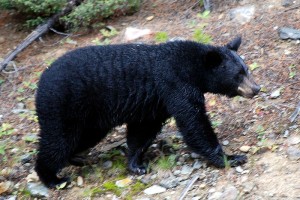
Black bear

Black bear in the Canadian Rockies

Like so many common names, the name black bear is really not very good since the animals are often many other colors than black. The fur comes in shades of blond, black, brown, cinnamon, and gray. Interestingly, the bears tend to be black in the eastern forests, and more color variation is introduced as you survey the populations to the west, such that in California most of the bears are brown.

The black bear is the smallest of the bear species, and the most common, with the widest current distribution. They are found across Canada and south through New England into the Appalachian Mountains. There are populations in the Ozarks and in the southern states. In the west they can be found through the Pacific Northwest, and through the Rocky Mountains south into Mexico.

Black bears are generally shy and reclusive, but they can become accustom to humans, especially when they learn to associate human activity with food—through trash or handouts. In many backcountry areas where bears are common officials try to keep bears and people separate, but it is not always possible. Food storage is a great concern when camping. For example, while camping at one remote location in the Great Smoky Mountains campers were to hang their food from a cable over a stream.

Hanging a food pack over a stream in bear country

Hanging a food pack over a stream in bear country

Incorrectly hanging your bag could lead to a bad time.
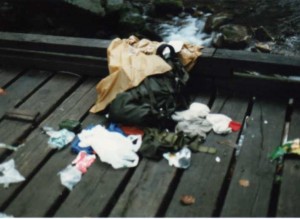
Results of improperly hanging your food pack

Results of improperly hanging your food pack

Brown bears are similarly misnamed, although the color variation is less dramatic than their black bear cousins. There are several subspecies, or races, of brown bears that you may have heard of, dividing them into coastal Kodiak and inland grizzly populations, but they are all the same species.

Brown bear

Brown bear

While once much more wide-spread in their distribution, brown bears are limited today to Alaska and northwest Canada, with several populations in western United States parks such as Glacier and Yellowstone.

Encounters with polar bears are understandably rare given the remoteness of their habitat. (See why polar bears are sensitive to climate change.) Polar bears spend much of their time out on sea ice, hunting seals. However, unlike other bear encounters, most encounters between humans and polar bears seem to be motivated by predation—that is, the bear is looking to eat them.

Bear encounters do sometimes lead to injury or even fatalities, and as people spend more time in bear country, the chances for an encounter naturally go up. In encounters that go badly, injury is more common than fatality as bears most often attack when they feel threatened, and once the threat is over they tend to leave. Rarely do bears prey on humans as a food source, but it does happen. In general there are about 1.8 bear-caused fatalities per year (see Clark 2003, Gunther and Hoekstra 1998, Herrero and Fleck 1990, Herrero and Higgins 1999 for discussions).

Of the dangerous animals discussed in the series, bears are the ones that most people need to be aware of, and to think about when entering the woods. Do not do stupid things in bear country, like walk around imitating the sounds of animals to attract bears (yes, it has happened), improperly store your food, try to feed the bears, get too close while taking pictures, or tease or taunt the bears. Common sense and awareness that these majestic creatures are sharing our woods will ensure that your adventures will have only the typical amount of excitement.

Associate Press. 2010. Bear who mauled caretaker is put to death in Ohio. NPR. http://www.npr.org/templates/story/story.php?storyId=129321688.

Clark, D. 2003. Polar Bear – human interactions in Canadian National Parks, 1986-2000. Ursus 14(1):65-71.

Gunther, K. A., and H. E. Hoekstra. 1998. Bear-inflicted human injuries in Yellowstone National Park, 1970-1994. Ursus 10:377-384.

Herrero, S., and S. Fleck. 1990. Injury to people inflicted by Black, Grizzly or Polar Bears: recent trends and new insights. Bears: Their Biology and Management 8:25-32.

Herrero, S., and A. Higgins. 1999. Human injuries inflicted by bears in British Columbia: 1960 – 97. Ursus 11:209-218.