Monthly Archives: September 2010

Fossil tells a new tail

Mosasaurs lived in the world’s oceans during the Late Cretaceous, the last Period from the Age of Dinosaurs (see the geologic time scale). They are close relatives of modern snakes and lizards, and during the Cretaceous they become fully aquatic sea monsters, growing to tremendous sizes, and were the top predators of their environments.

Their fossil remains occur in great numbers in the marine chalk deposits of the Central Plains, and numerous specimens have been preserved in museums all over the world (see posts on the chalk formation and on rock formations in general). Yet despite the great numbers of specimens collected, we still have much to learn about these great beasts.

For example, examination of their bones shows that they are elongate animals, with enlarged tails for propelling their bodies through the water. Their limbs are modified into flippers, useful in controlling the direction and orientation of their bodies in the fluid medium. So, it is clear that they are primarily tail-swimmers.

Early restorations based upon this evidence imagined a tail sort of like a modern crocodile, a thick tail that was slightly compressed laterally, making it taller than thick, but remaining relatively snake-like. Early restorations of the skeleton articulated the tail as a long chain of vertebrate, continuous from base to tip without any remarkable difference along the way.

Here is an illustration of the skeleton of the mosasaur Platecarpus from a classic work on mosasaurs (Williston 1898). Note the rod-like straightness of the back.
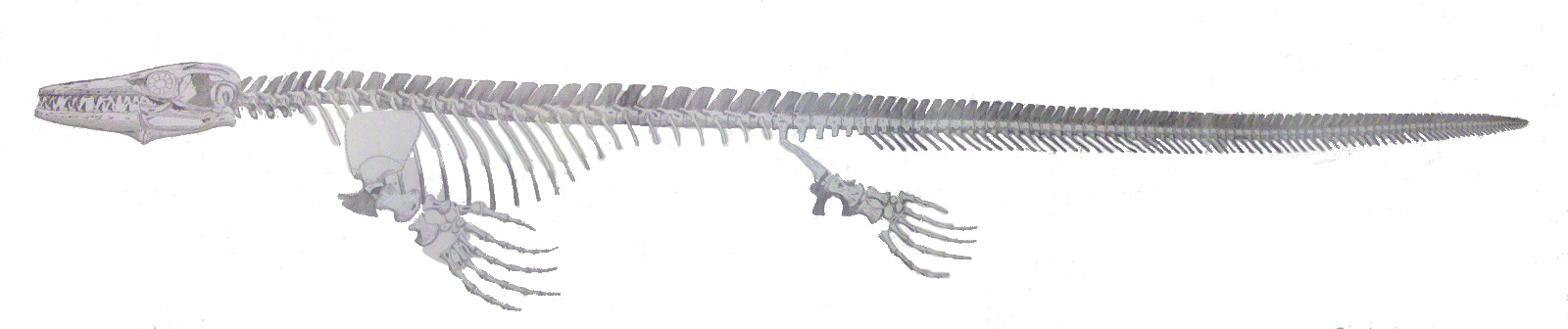
Mosasaur Platecarpus from Williston

Mosasaur Platecarpus from Williston

And here is an artist’s illustration of Tylosaurus, the largest of the mosasaurs, from Mike Everhart’s Book, Oceans of Kansas, showing the tail with a slight thickening near the end, but mostly being straight (Everhart 2005, recommended in the Boneblogger store).

Mosasaur Tylosaurus

Mosasaur Tylosaurus from Oceans in Kansas by Mike Everhart

However, frequently the skeletons of mosasaurs were found preserved in the rock with the last third of the tail bent downward, away from the main axis of the base of the tail. And this was not just found in a few skeletons, but it was found frequently enough that scientists speculated, at least in conversations with each other, that perhaps the down turned tip was not an artifact of preservation, but maybe meant something.

Well, a newly described mosasaurs fossil, which has exceptional preservation, provides the answer. This specimen collected in Kansas and now at the L.A. County Museum, preserves not only the bones, but also impressions of skin, impressions of internal organs, and even some of the body outline. The bones of the tail are clearly down-turned, giving the authors of this new study enough confidence to state what has been quietly talked about before—mosasaurs had a bi-lobed tail fluke (Lindgren et al. 2010).

Mosasaur Platecarpus

Mosasaur Platecarpus showing revised body outline

It only takes a single fossil to help overturn past notions about prehistoric life. The next big discoveries are out there, in the rocks and sitting in the museum drawers, waiting to be examined in detail. What will we find next?

Everhart, M. J. 2005. Oceans of Kansas: A Natural History of the Western Interior Sea. Indiana University Press, Bloomington.

Lindgren, J., M. W. Caldwell, T. Konishi, and L. M. Chiappe. 2010. Convergent evolution in aquatic tetrapods: insights from an exceptional fossil mosasaur. PLoS ONE 5(8):e11998.

Williston, S. W. 1898. Mosasaurs. University of Kansas Geological Survey 4(1):81-347.

3D Scanners In Archaeology

3d scanners are relatively new technology. Only the advent of the laser and computers has allowed for the transfer of all details about an object into a computer, and possibly the manipulation of these items with computer aided drawing (CAD) software or similar software. 3d scanners have a huge variety of uses, but perhaps the best use is for reverse engineering and cultural purposes.

Such devices have been used by archaeologists since the invention of the technology. This application is excellent for the purpose of finding hidden details in an artifact or piece of artwork that are too small for the eye to detect it. Also, as the technology typically uses lasers or sound waves for the purposes of scanning the object, it is minimally invasive. For example, a scientist or historian may want to know more about the content of an oil painting and the chemical properties of the paint. He or she could take a small chip of paint out of the painting, but if the painting is historic enough, that likely would not be allowed. However, oil paint is very well known for accumulating in large bumps, with a lot of texture. A 3d scan of the painting could likely give enough information about the structure of the painting to figure out the contents of the paint.

There are a number of famous examples of the use of 3d scanners in archaeology. Perhaps the earliest is two different groups of researchers who were able to scan Michelangelo’s famous statue David in 1999. Both of these groups used scans at a resolution of .25 mm, which accumulated a huge amount of data, detailed enough to see the chisel marks. These data were able to tell the researchers a large amount about how the statue was made, what tools Michelangelo had to work with, and other important archaeological information. Today, most famous works of art have been subject to the same treatment. And best of all, it is completely noninvasive.

Coyote Hunting – Varmint Hunting at Its Finest

Coyote hunting season is one of many hunters’ favorite times of the year. Starting in October and lasting through the spring, many who live in the Midwest and Western states of the United States, as well as many countries in Europe, relish the challenge of pursuing these wild dogs. Many others however view coyotes as varmints and hunt them only to preserve their livelihoods and their cattle or sheep. Still other hunters prize the animals’ furry pelts. There are some states, such as South Dakota, that permit licensed varmint hunting year round, while other states have specific hunting seasons.  It is critical that the hunter be well versed in the regulations of the state where the hunt is taking place.

The prime coyote hunting months in most areas are the months of December, January, and February.  The heavy snowfall experienced in many of the coyote’s habitats is a boon to hunters, making the animals highly visible against the stark white background.  The dogs’ pelts are also in prime condition during the cold weather months. Add to this the fact that breeding season begins in January and extends until mid to late February and the winter is perfect varmint hunting time.  It also helps that the animals are a wee bit distracted when females are in heat and this helps the hunter chase this normally wary creature.

Finding the best area to place the stand is a challenge for hunters. If the hunter can locate the coyotes’ den areas then it is a no-brainer to locate the stand in close proximity. Since coyotes are opportunistic predators, they love to hang out around barns, pastures and any other areas where there are herds of livestock available for the sampling.  Securing the permission of a ranch owner or farmer to hunt on their land can be a real advantage when chasing coyotes.  All hunters who enjoy the sport know not to hunt on any privately held land without the owner’s permission. Not only can the trespasser be arrested, but he may also be subject to the sound of shotgun fire if found on someone else’s land.

Learning and using calls is key to coyote hunting success.  There are a couple of types of calls used in the sport.  The first is known as a locator, a call that mimics the howl of the dogs and determines if they are in the area. In addition to the howling sound, these calls can mimic the coyotes’ yelps and yips. The second call is one that imitates the sound of another animal in distress and leads the varmints to believe that an easy supper may be in the making. The sound of a wounded rabbit is one of the favorite coyote calls. These different calls are not easy to master, but a little bit of time spent studying a few good coyote hunting videos will really help the beginner.

The choice of preferred gun for the hunter is as varied as the hunters themselves.  The pursuit of wild dogs can involve both long range and close range shooting and for this reason, many hunters prefer a gun that is a combination of shotgun and rifle.  One weapon worth consideration is the Savage 24F.

Coyote hunting is done for many reasons. Whether for pelts, livestock protection, or simply sport, it is a favorite of many hunters as it has been for many, many years.

Diving and Snorkeling Sites of Your Dream

When you plan a vacation, you want to get the best of your legitimate leisure time, and you want to spend every minute of it. Usually people look at what sightseeing or accommodation this or that spa place offers, look at hotels, restaurants and entertainment facilities on land, but you as a snorkeling enthusiast or diving aficionado you want to look deeper in the main meaning of this word, “deeper”. I always want to explore what is hidden underwater. I enjoy kelp forests and prolific reefs, with tons of invertebrate life sliding in pristine water.

Of course, every person has his own taste, and what is good for one person may be poison for another. There is a proverb in Russian, “What Russian person enjoys is death for a German person”. Even though this proverb goes into World War II times, it means that you cannot tell universal truth about what is best, especially when it relates to vacation or tastes.

Some people like active vacations, with adrenaline levels going all the way up in their blood, going as far as possible and as deep as possible to meet the most strange creatures underwater that can swallow or bite you, or sting you. But sometimes these animals are not as dangerous as they seem, like in Stingray City where they behave like domesticated pets. (See the Dangerous Animals series.)

Other divers prefer picturesque kelp forests and reefs full of rainbow-colored fish, and are happy to explore dive sites that are not far away from their home, like California’s Channel Islands. Still others enjoy ship wreck diving, with sunken ships from the days of yore, like a 19th century wooden-hull schooner that is nicely preserved in cold water.

What you should never forget about is your diving gear, including your diving knife (you need it in case of emergency) or underwater digital camera (to have the best memories of what you have seen or experienced).

History of Russian diamond production

Because Russia is such a cold country, for many years it wasn’t really cost effective for Russian miners to go to the trouble of extracting diamonds from the cold Russian tundra. It is only in the last half a century that Russia has been mining and producing Russian diamonds, although the diamonds have, of course, been under Russian soil for much longer.

The impetus for the decision to mine diamonds – the ultimate symbol of luxury –was ironically that they were needed to boost the industrial output of the communist Soviet Union. As well as being sparkly, diamonds are important for use in industry – they make extremely hard and long lasting drill tips. They also have military uses, which made them extremely attractive to Soviet planners.

So, in the 1950s massive mines were started (the largest was the Mirny mine, an open cast mine that is over a kilometer wide and almost a kilometer deep and which has been made famous on the internet by people who circulate amazing pictures). The Soviet Union never did things to a small scale.

Diamond production in the Soviet Union was mainly aimed at industrial production, but it was quickly realized that many of the diamonds being mined were good enough quality to be sold as gemstones for jewelery. A top secret deal was agreed with De Beers to sell them outside of Russia, and the Soviet Union very quickly found it had another major source of income that it could use to support its ambitions.

Today, diamond mining continues in Russia – still on a grand scale. This year, in fact, it was reported that Russia is the world’s largest producer of diamonds – it produces almost one in every four diamonds in the world today, an amount which is worth well over $1billion dollars annually to the Russian economy.