The 1993 movie Jurassic Park, based on the book by Michael Crichton and directed by Steven Spielberg, is seen by most enthusiasts as the best dinosaur movie that Hollywood has produced. It set a high-water mark in the genre for many reasons: it took dinosaurs seriously as a topic, and did not portray the animals simply as ridiculous extras; and the movie was amazing for its visual effects. For any movie from Jurassic Park onward, your dinosaurs had better look real, scary, and believable.
Jurassic Park was also important in that it showed dinosaurs more or less accurately, consulting with real paleontologists in its making, and working to utilize the latest and greatest views on dinosaurs. This is not to say that they did not put in a Hollywood spin, or as I have called it in the past, “Spielbergize” some of the dinosaurs, but as a paleontologist I could really see that the ideas were not completely out of the blue. In fact, Spielberg foreshadowed some of the findings about dinosaurs that were to come.
I want to review some of the key features of Jurassic Park as they were thought of in Hollywood in 1993 and compare that with the state of the art today.
Dinosaur DNA
The entire premise of Jurassic Park is that DNA from extinct species was collected and cloned in order to bring the animals back to life. Are we any closer to being able to do this? Well, not really.
The complete DNA code of any single species is very long and complex, and it is very unlikely that any DNA molecule will survive intact for millions of years. We cannot even clone species that are modern or recently extinct with much success, and we have access to their DNA. The technical difficulties of getting DNA intact, knowing how to put that DNA together on chromosomes, knowing how to trigger the genes on the chromosomes to turn on and off during development, means that even if we could somehow get a complete dinosaur DNA sequence, we could not make a living animal.
However, there have been some amazing advances in molecular paleontology, where protein fragments and amino acids have been shown to be able to survive within fossil bone for an extraordinarily long time, much to the surprise of scientists who assumed that fossilization would destroy the tissues at the molecular level. Making predictions is difficult, especially about the future. Who knows what discoveries await us, but for now, the current best answer is that we will never be able to clone a dinosaur. (See Mammoth protein designed to be cool for more on molecular paleontology).
Excavation Scene
Early in the movie we are treated to a scene of a paleontology excavation as modern paleontologists dig into the past to understand dinosaurs. As with any profession, portrayal in a movie is not often close to reality. Cop movies do not realistically show what it is like to be a cop. Lawyer and doctor movies stretch the true on those professions, and the excavation scene was the one where me and my professional colleagues got a good laugh.
We see the field crew effortlessly dusting sand away from crisp fossil bone. We see the team firing off seismic charges to send waves into the rock to visualize complete dinosaur skeletons underground, just waiting to be effortlessly dug out. Oh boy. This is so far from the truth.
We cannot simply use a type of remote sensing technology to visualize unexposed fossils, however there are a few technologies that people have tried to use. Sometimes the minerals that fill fossil bone have a higher concentration of radioactive elements, and so mapping the concentration of radioactivity over a site has helped to locate concentrations of fossils in those cases. There is a technology called ground-penetrating radar which under certain circumstances could be applied to fossils, but its use is limited. The main problem with both of these techniques is that to find fossils underground, you have to be able to tell them apart from the surrounding rock, and too often the fossils are very similar to the rock that encases them.
Fossils are still found the old fashioned way—by looking for bones weathering out on the surface, and digging around them in hopes that something more is there.
And of course, it is not as simple as dusting them off. Fossils are often enclosed in a hard matrix of rock, which can take many hours of tedious labor to remove. Frequently in the field the fossils are exposed enough to understand how they are laid out, and then removed in giant blocks to be worked on back in the museum lab for the next several years.
Velociraptor
The undeniable stars of the movie were the “raptors.” As shown, they were cunning and relentless killers, bent upon creating havoc for their human character counterparts. In the movie, the velociraptors were shown to be about as tall as an adult human and perhaps 12 feet long nose to tail. That was an exaggeration to say the least.
Real velociraptors have been excavated in Central Asia, and are not known from North America as fossils. However, there are Velociraptor relatives known from this continent. But in life, real velociraptors were only about half the size shown in the movie, maybe the size of a mid-sized dog.
However, Spielberg did not know it, but his velociraptors did not have to be exaggerated in size if he had just said that they were a dinosaur species that was discovered in 1991, and named in 1993—Utahraptor (Kirkland et al. 1993). The same year that Jurassic Park was released also saw the emergence of Utahraptor, a dinosaur that much better fits the dinosaur shown on film. It was discovered in North America, as was suggested for Velociraptor in the movie, and was the size of the animals shown in the film. So, in a way, Spielberg was showing a real dinosaur, just not the one he thought.
Tyrannosaurs Running
It might be a close call as to which was more popular in the movie, Velociraptor or the seminal favorite dinosaur Tyrannosaurus. Who did not thrill to see the giant animal trash Jeeps, eat lawyers, and run amuck? In a harrowing scene, tourists of Jurassic Park are chased at top speed by the Tyrannosaurus and only just manage to escape in their vehicle.
Could Tyrannosaurus almost outrun a Jeep? Well, likely not.
Large animals today do not run well. The heavier an animal is, the more force there is on the animal’s joints and bones, and running compounds the effects of those forces. Modern elephants cannot run, but rather trot. They can move quickly, but they are too large to achieve a full-scale run.
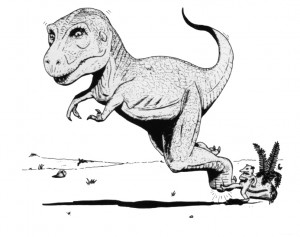
How to kill Tyrannosaurus, from Farlow, Smith, and Robinson, Journal of Vertebrate Paleontology, vol 15(4).
Likewise, tyrannosaurs were very large and heavy animals, and there are physical constraints based upon the strength of their bones and joints. And unlike an elephant, Tyrannosaurus supported all their weight upon two legs, teeter-tottered over their hips. Running would have placed tremendous stresses on the hip joint.
Also, unlike an elephant, the large head of a tyrannosaur was extended out over the ground, as much as 15 feet above the surface, and they did not have forelimbs of any size to speak of. This means that if they did get up to a significant running speed and were to stumble, their heads would fall with great force to the ground without any way to break the fall. In short, if they did run and fall they would bash their brains out on the ground. Running, in this case, would be fatal.
Venomous dinosaurs
In Jurassic Park, the dinosaur Dilophosaurus was portrayed as being able to spit blinding venom into its victim’s eyes. The suggestion that a dinosaur was venomous was groundbreaking. Earlier this year there was a report of the discovery of a venom delivery system in a raptor dinosaur, Sinornithosaurus (Gong et al. 2010), seeming to once again make Spielberg a paleontological prognosticator.
However, it does not seem likely that the interpretation of Sinornithosaurus as being venomous will stand up to further scrutiny. Secondary investigations of the fossils suggest that characters which were viewed as supporting a venom delivery system are actually not what they were first thought (Gianechini and Agnolin 2010), so it looks like we still have to wait to find a venomous dinosaur, much less one that can spit!
Jurassic Park stands as one of the greatest dinosaur movies. From a paleontology stand point, while the movie is fiction several interesting propositions were shown, and this is, after all, what drives our curiosity to explore.
References:
Gianechini, F. A., and F. L. Agnolin. 2010. A reassessment of the purported venom delivery system of the bird-like raptor Sinornithosaurus. Paläontologische Zeitschrift.
Gong, E., L. D. Martin, D. A. Burnham, and A. R. Falk. 2010. The birdlike raptor Sinornithosaurus was venomous. Proceedings of the National Academy of Sciences 107(2):766-768.
Kirkland, J. I., R. Gaston, and D. Burge. 1993. A large dromaeosaur (Theropoda) from the Lower Cretaceous of eastern Utah. Hunteria 2(10):1-16.
Related Posts:
Learn about dinosaur toys
Dinosaur excavation in the Purgatoire River Canyon

