Monthly Archives: March 2010

SuperCroc at Sternberg

The Sternberg Natural History Museum at Fort Hays State University is featuring a new exhibit, The Science of SuperCroc from now until August 5.

The star of the show is the African crocodilian species Sarcosuchus whose remains have been found in the modern Sahara, in the Elrhaz Formation. This Early Cretaceous (~112 million years ago) crocodile had a long, slender snout with a prominent down-turn or hook at the tip. When fully mature it is estimated to have been between 37-40 feet in length, and weighed as much as 17,000 pounds.

The largest living crocodile is the saltwater croc, and the largest confirmed individual was just over 20 feet in length and weighed a mere 2,600 pounds.

Restoration of Sarcosuchus, the SuperCroc

Restoration of Sarcosuchus, the SuperCroc

Sarcosuchus had its eyes placed high upon its skull suggesting that it spent most of its time submerged in the water. Like so many other things in paleontology, the question of what Sarcosuchus may have eaten is not agreed upon by researchers. Some suggested that the size of Sarcosuchus and its overhanging upper jaw made it able to wrestle large prey items, even massive long-necked sauropod dinosaurs. Others point to the slenderness of the muzzle and it not looking stout enough to withstand the forces that would be required to bring down large prey. There were plenty of lobe-finned fish in Sarcosuchus’s environment. I see a fish-eater in this skull myself.

Also on display with the large croc is Suchomimus, a theropod dinosaur whose remains have been found in the same geological formation as Sarcosuchus. Suchomimus, whose name means crocodile mimic, was a forty-foot long beast which also had a long slender muzzle. Its forelimbs were armed with very long sickle-curved claws. This animal is thought to have eaten fish and probably other sorts of meat, but its skull also does not appear equipped for biting and holding very large struggling prey.

Super Croc Sarcosuchus skeleton at Sternberg Museum

SuperCroc Sarcosuchus skeleton at Sternberg Museum

The presence of both of these animals, and many others found with them, show that the Sahara area of today was a lush, swampy habitat in the Early Cretaceous. The effect of climate change and plate movements over millions of years can turn a wet verdant habitat into a harsh, dry desert. My how times change.

Go see SuperCroc at the Sternberg Museum if you have a chance.

It has what?

Here we will explore some of the more specialized pocket knife accessories you can get on your knife. This gets into the world of gadgets and gimmickry, and in the extreme cases, just plain silly.

At the low end of the spectrum we have pocket knives with multiple blades. In an earlier post I gave my general opinion about them, but some people will find them useful. They are especially useful if the second blades have a different function than the main blade. For example, fishing people will appreciate knives with the second blade being a fish scaler.

Another tool that looks handy for the upland bird hunter is the bird hook. I have read several descriptions for how to use it, but in general you cut open the abdominal cavity of the bird and fish the hook around inside to pull out the entrails more or less in one swoop. Having gutted many birds, I may look into this tool myself.

Other tools that seem at least somewhat useful include a bartender’s pocket knife with blades for cutting foil from wine bottles and a cork screw. Although, I think there are likely better cork screws on the market.

Then there are the proverbial “Swiss Army knives.” I don’t know what the Swiss Army does, but for a neutral country they seem to need a lot of stuff. On one model you can get: 18 Implements with 31 Functions; black rubber grip; 2.50 inch locking blade; double-cut wood saw; adjustable pliers w/wire crimper and cutter; fish scaler; hook disgorger; line guide; magnifier; screwdriver; metal file; metal saw; compass; straight edge; ruler; springless scissors; universal wrench; and an additional 9 unspecified implements with 14 unspecified functions.

Personally, I have never really been too impressed with the Swiss Army knife concept overall. It just seems to me it tries to do way too much and ends up not doing any of it very well. However, many people must like them. I guess I might be more impressed when they come out with one that can locate fossils.

Pocket knife basics

When considering a pocket knife to carry several things are important to me. Perhaps size and weight are the most significant. If the knife is too large or heavy you will end up leaving it home on your dresser rather than tossing it into your pocket or purse.

Many pocket knives have more than one blade. This could be handy I guess if the second blade is a different shape or design than the first. For example, if the second blade is considerably more pointed than the first and could be used for different tasks. In general though, I don’t find second blades terribly useful.

Locking blades are a different story. Many modern knives have some sort of locking mechanism that snaps into place and keeps the blade from folding back into the handle while in use. This can be an important feature as you might be surprised how many times you are working with the knife, and all of the sudden feel it give way, with the blade coming dangerously close to your fingers as it closes. For really casual use this might not be a necessary feature. In another post, (pocket knife introduction) I mentioned the knife I carry much of the time, and it does not lock. But if you are likely to use the knife much at all, getting a blade that locks is incredibly handy, and can be much safer.

Blade length is related to overall size and weight. For almost all everyday uses a blade of 2 inches is perfectly fine. I would not recommend carrying a blade of more than 4 inches as the knife starts getting big and heavy, and the extra length is really not needed in most everyday uses.

If you really expect to use the knife for more moderate- or heavy-duty uses, a heavier knife is warranted. Get the right tool for the job. Outdoors adventurers, hunters, fishers, campers and the like will likely use the knife for everything like cutting rope, digging into rocks (yes, I have), prying open cans, whittling marshmallow sticks, slicing cheese and lunch meat, and a host of other activities. For these sorts of uses a larger, stouter blade is needed. If you intend to carry it in your pocket, I still would not recommend a blade longer than about 4 inches. Much longer and the knife is just too uncomfortable to carry.

If you are expecting much more heavy use you might want to consider a fixed blade hunting knife, the kind with a sheath that does not fold at all. The fixed blade is a single piece of steel with the handle, making it much stronger overall. Pocket knives are great to have handy, but there are limitations to what you should expect them to do.

Scientifically Authenticated Dinosaur Model Kits Now Online

Guest Post

For the Dinosaur connoisseur and collector, you will find what you have been looking for at Dinosaur Model Toys.com. The creator of all the works featured on this site is not only a gifted sculptor, but actually works with dinosaur fossils as a paleontological reconstruction artist, fossil preparator, and field technician at the Natural History Museum of Los Angeles. His artwork is based on the latest scientific research, real fossil material, and years of hands on experience. This is why the work featured is regarded as some of the most scientifically accurate available to the public.

The new Dinosaur Galleries at the Natural History Museum of Los Angeles will feature many of the artist’s creations. Most notable is the baby Tyrannosaurus rex estimated to have been two years old when it died, for which nearly ninety percent of the skeleton will be recreated for this mount. This sculpted reconstruction will be featured with two real T-rex specimens, one a six-year old, and the other the sub adult specimen named “Thomas” which Doyle Trankina helped collect, and prepare. Thomas is estimated to be about seventy percent complete, making it one of the top five most complete in the world. Our initial offering will be a series of cast resin models and limited edition bronze sculptures with both a highly detailed exterior view, and a rendition of the internal skeletal anatomy of an adolescent T-rex similar to the Thomas find.

As part of the Dinosaur Institute at the Natural History Museum of Los Angeles Doyle Trankina has attended several field excavations in Montana, Utah, and the Mojave. While in the field Doyle prospected, and assisted in the collection of several specimens, most notably Thomas the sub adult Tyrannosaurus rex that will be gracing the museum’s new Dinosaur Gallery in 2011. Through his experiences with the museum with his private obsession with prehistoric life and the natural world, Doyle has produced several sculptures and illustrations for exhibition and publication. Doyle has an extensive list of sculptures to produce over the next two years. His work will require lots of observational study from the museum’s collection, and extensive extrapolation based on the latest research, and modern analogues like birds, and crocodiles.

After completing the preparation of Thomas, Doyle embarked on a half skeletal, half flesh reconstruction of an adolescent Tyrannosaurus rex at 1;24th scale. The detail and fidelity to the skeleton was accomplished by long study of the anatomy from several existing mounts, scientific publications, and photographs from the some of the best Tyrannosaurus specimens. The teeth were surfaced to provide the accurate thickness and semblance to where the tinny serrations would have lined the many teeth. Because the position of the serrations actually change on the teeth as they move back towards the throat, the ridge implies the appropriate location of the serrations. The scales were carved individually so that the skin wraps around the form in a realistic, and accurate way.

Doyle is currently working on a skeletal reconstruction of a baby Tyrannosaurus rex which will be mounted in the new Dinosaur Galleries with Thomas and an intermediate specimen as an illustration of age progression. The actual specimen is only known from a skull fragment from the snout of what is believed to be from a two-year-old Tyrannosaurus rex. There are no post cranial remains, and there are only a handful of examples that are believed to be that of baby dinosaurs. This project has just begun, and with Dr. Chiappe Doyle will be making history in presenting the worlds only mounted baby Tyrannosaurus rex specimen.

Fall of 2009 marked one of the biggest Paleontology news splashes, featuring N. America’s smallest dinosaur, Fruitadens haagarorum. Nearly 150 million year old, the tiny Fruitadens would have shared its life with such titanic beasts as Brachiosaursus, and Allosaurus in the late Jurassic. It is thought that the animal might have weighed as little as two pounds and measured only 28 inches in length. Fruitadens was discovered in Colorado in the late 1970s in a geological formation known as the Morrison, more specifically in an area called Fruita, for which the specimen was named after.
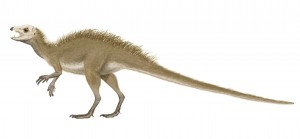
Artist reconstruction of the dinosaur Fruitadens

Artist reconstruction of the dinosaur Fruitadens

The strange dentition of this animal implies that Fruitadens might have been omnivorous, eating plants and at least insects if not small vertebrates. Doyle has produced the first and most accurate illustrated and sculpted reconstructions of this animal. Fruitadens belongs to a family of early dinosaurs called heterodontosaurids, which share many interesting features, one of which are the teeth. Fruitadens like other heterodontisaurids have varied dentition, and in the front of the mouth sits a canine like tooth on the lower jaw. His work was featured on every major news source in the world, and five of the sculpted Fruitadens will be featured in the new galleries in 2011. In his studio, Doyle is currently working on a scale Fruitadens, which will be approximately 30cm long . This will be the only scaled sculpture of the animal, and the first and only for sale. The full scale version is not for sale and can only be seen at the Museum.

Doyle is also concurrently working on Mamenchisaurus, a long neck dinosaur and part of the branch of Sauriscian (lizard hipped dinosaurs) known as Sauropods. As the prospects of obtaining a casting of the Chinese mamenchisaur skull proved too difficult, Doyle was charged with the task of reconstructing the skull from two dimensional reference and other dinosaurs like Camarasaurus for comparison, and to gain familiarirty with Sauropod skull anatomy. The rare skull was found in China and researchers provided a paper with a detailed description and several scientific illustrations. Sauropod skulls are rare because they are so frail in construction, have several small bones that usually disarticulated some time after the animal dies, and are not commonly preserved in fossilization, or are so disarticulated and in such small pieces that they are nearly impossible to find.

Doyle Trankina is a sculptor, illustrator and fossil preparator at the Los Angeles Museum of Natural History. For unique scientifically authenticated Dinosaur Art, Dinosaur Models and Dinosaur Resin Model Kits, visit his online store Dinosaur Model Toys.Com.

Many other interesting dinosaur facts can be found here at Boneblogger.

Knives For Hunting Also Have Many Other Uses

If you are gathering together the things you will need for an extended journey into the great out of doors, then any experienced outdoorsman will tell you that proper knives for hunting are essential. This is because having a quality knife near at hand will be very useful during your journey and not just for the obvious uses of cleaning and skinning any of the game you successfully bag. A good knife will also be very handy if you encounter a wild animal that might attack or for trimming branches in order to set up camp.

As with any other type of instrument for cutting, hunting and fishing knives must be well cared for and maintained in order to extend their life and to make them as useful as possible. When one is out on a hunting, fishing or camping expedition, it is important to be sure that the fixed blade hunting knives or folding hunting knives that you take along are ready at a moments notice to do their job. This means they should be clean and recently sharpened. In the instance of folding or pocket knives, they should be oiled so that the blade can be accessed easily and quickly.

For those who use their knives for hunting on a daily basis for other purposes, it is a good idea to clean the knife daily or after every use. This helps to keep not only the blade in the best condition possible, but the entire knife as well. If the hunting knife is properly cleaned, then you can see if there are any nicks or damages to the blade.

If you do see that the blade has been nicked, it is important to hone out that area as quickly as possible, and most certainly before using the blade again. This will keep the blade from becoming even more damaged and will also assure that you always have the sharpest cutting edge on your knife at all times. A dull blade can be dangerous to the user, as more pressure is required and in such circumstances the blade is more likely to slip and cause an injury to the user.

Hunt and fish knives typically end up being used to skin, gut and clean animals and fish that has been killed or caught, and as a result they can become very dirty, very quickly. Out in the wild it is not always possible to thoroughly clean a knife that has just been used, but at the very least the blade and handle should be wiped down to remove as much blood and tissue as possible.

Upon returning to camp, it is best to completely wash the knife with soap and water to rid it of any residue and dirt left on the blade and handle. There are also a number of cleaning solutions on the market which can be very useful in keeping the knives for hunting in good condition and which can easily be taken along on your next hunting trip. Visit www.lightsandknives.com/hunting_knife_sharpening.htm for tips on how to maintain your knives in good condition.

Want to find out more about knives, then visit Tim Frazier’s site on how to choose the best folding knives for your needs.

Also see what you should look for in a hunting knife.