Monthly Archives: March 2010

Give Yourself An Edge With This Carp Fishing Gear

Guest Post

When it comes to fishing, the biggest draw to freshwater fishing right now has to be carp fishing. This is the same throughout America as much as Europe. People just can’t seem to get enough. There might not be a considerable difference between fishing for carp over fishing (rod and reel) for anything else, but there are some differences to be presented. One of which is carp fishing gear. If you are serious about catching carp, you ought to educate yourself on the necessities.

When you think about carp fishing gear, you should be thinking a few things specifically. These being: the rods, bait, and line.

Getting a rod to specifically go carp fishing is a possibility for the serious carp angler. The difference in these rod and reels over the competition of other fishing types is generally the length of the rod. Carp rods get to be about 12′ long and with very good reason. If you are pulling in a 45 lb. Monster carp, you don’t want to lose your rod to the tension and pull of the fish. A longer rod simply gives you more leverage. They start around $25 for a low-end rod, but the best rods will run you around $150. The difference is the makeup of materials, which greatly affects the rods endurance and overall durability in clutch situations.

Perhaps the most important part of fishing for carp exclusively is getting bait that carp exclusively enjoy. Granted, this is not to say that some other fish isn’t going to be enticed by what you have dangling in the water, but you will land more carp by getting the right baits. Some of the companies that make some great bait to land big carp are K-1 and Kryston. They both claim to have some great concoctions of proteins and enticing elements that carp simply cannot ignore.

Getting appropriate line is pretty crucial to your cause as well. If you have insufficient line, then you might not have the carp either. Some carp can get over 50 pounds, and so you have to have a line that can withstand the thrashing and evasiveness of a 50 pound fish. Most often carp range in the 10-20 pound range, yet you don’t want to plan for this being your maximum. Planning ahead can be the difference between the big carp and the big story about the big carp.

The most important aspect of carp fishing is technique and practice. No amount of great gear will live up to real experience and knowledge. Raw skill comes from practice, and no carp can resist the bait of an angler like that.

So if you are confident in your abilities and just want to get an edge, you should definitely check out some of this incredible carp fishing gear.

If you would like to know more about used cheap carp fishing gear, please feel free to visit that page or have a look at this carp fishing blog.

Niobrara Chalk

One of the most famous formations is the Niobrara Chalk. This formation is exposed in northwest Kansas and southern Nebraska. Formations are sometimes divided into members, subsections of the formation based upon its rock type. The Niobrara Chalk has two members: the lower Fort Hays Limestone and the upper Smoky Hill Chalk. It is the Smoky Hill Chalk which is best known for its fossils.

The sediments that comprise the Niobrara Chalk were deposited in the Western Interior basin during the Late Cretaceous. At that time sea levels rose and the interior of North America was inundated by a shallow sea, the Western Interior Sea. The sea cut North America in half by spreading from the Gulf of Mexico to the Canadian Arctic. Volcanoes to the west, in what is now Utah and Nevada, spewed ash into the sea and sediments eroded from mountains along the western coast were washed into the sea by rivers. What is today Kansas was much closer to the eastern shore of the sea, a low alluvial plain, also gently washing sediment into the sea basin.

Block diagram of the Western Interior Sea

Image from Hattin, 1982.

The upper member, the Smoky Hill, was deposited from 87 to 82 million years ago, so it preserves a five million year window into the past. Elsewhere we discussed that the Cretaceous sea had a wealth of planktonic organisms. Many of those organisms had calcium carbonate-based shells and body parts, which furnished a steady supply of material to sink to the sea floor. The consistent supply of sediment, both from land and sea, and conditions at the sea floor allowed for the excellent preservation of animals. Those that died and sank to the bottom were rapidly covered by the rain of sediment and entombed until today.

And the diversity of organisms preserved is amazing. In almost every museum with fossils that I have been in, I recognize fossils from Kansas. Giant marine reptiles (mosasaurs and plesiosaurs), flying reptiles (pterosaurs), great toothy fishes, large turtles, and toothed diving birds have all been found. Each of these groups has a very interesting story to share, and we will explore many of them here. An extensive website on fossils from the Niobrara Chalk can be found at OceansofKansas.com.

Pocket knife introduction

When I was growing up I was rarely without my pocket knife. I carried it everywhere, even to school, and never thought twice about it because it was such a basic tool to have available. Of course, today, I would guess that schools take a dim view to kids carrying pocket knives, and do not even think of carrying one through the airport security check. It is unfortunate that such a useful tool is getting left out of people’s lives more often these days.

Because of this perhaps, I find fewer people with experience in using and selecting good pocket knives. The choices are overwhelming: there are so many kinds of blades and gizmos you can get; so many gimmicky kinds of things; and so many down-right impractical bits of advice. As I read around the web in preparation for writing this article I saw some bits of “wisdom” that really made me wonder. Some people suggested you might want your pocket knife to cut wire, or hack up tree limbs that fell in your back yard(!), neither of which I would recommend to say the least.

There are many uses for a good knife and thinking about how you are likely to use it will be a good indication of what to look for. Most everyday uses fall into the light-duty category, cutting tape on boxes, opening those ridiculously hard-to-open plastic product packages, cutting string, etc. Everyone should have a good general-use pocket knife for these uses. Many women carry them in their handbags; men often carry them in a pants pocket.

For almost all these uses you will not need a blade longer than about 2 inches. A 4 inch pocket knife is about the largest you would want to carry in my experience. Please avoid the “Rambo” temptation to get a large, nasty looking knife simply for the macho factor. That might be cool when you are 12, but most of those knives end up too heavy to carry and too big to be really useful in everyday life.

I have several knives that I routinely carry depending up my mood. The one I carry most I have clipped to my keys. It fits easily into my pocket and has a very effective blade of just 1.5 inches. This knife, made by Kershaw, has two blades. The main blade folds out like a typical knife—the second folds out with the sharp edge toward the first, turning both blades into a handy scissors. This little knife has kept its edge very sharp through lots of use, and I highly recommend it for most basic needs.

Giant Short-Faced Bear Reexamined

As the old saying goes, looks can be deceiving. That is the theme of a new paper on the Giant Short-Faced Bear (GSFB), Arctodus simus, recently published in the Journal of Vertebrate Paleontology (Figueirido et al., 2010).

We have explored this beast in other posts (see below), and will no doubt do so in the future, as it is one of my favorite animals because of the fascinating paradoxes that it presents. Bears as a group often do not do what we think they should do!

The GSFB is the largest mammalian carnivore known, fossil or recent. First discovered in Northern California and described by Cope in 1879, remains of this species have since been recognized from Alaska to Mexico, and from the west coast east to Pennsylvania in North America. It lived from about 1 million years to about 10,000 years ago. It is likely that they became extinct as an ultimate effect of climate change at the end of the Ice Age.

Kurten (1967) was one of the first to look at the GSFB in much detail, and he made a number of observations  that have come to define this bear: shortened face like a cat, and extremely long limbs compared to body length. Kurten argued that those adaptations show a hypercarnivore, a cat-like giant predatory bear, with long runner’s legs and a bite-style like the large cats.

There is something very appealing in this picture: a huge cat-like bear running down prey and dominating the Ice Age landscape. Alas, science cannot be based on drama or romantic notions, and this image of the GSFB gets reexamined from time to time, with other authors coming to different conclusions. Some have pointed out the ambiguity of the limb proportions, or compared the GSFB to its closest living relative, the South American spectacled bear, and concluded that it was primarily omnivorous with a diet rich in plants (Emslie and Czaplewski, 1985).

The question of what the GSFBs were eating, at least, seemed to have been dramatically concluded in a couple of papers during the mid-1990s (Bocherens et al., 1995; Matheus, 1995). Those authors explored the carbon and nitrogen stable isotopes preserved in skeletal material. You are what you eat as differing amounts of these elements are deposited in body tissues depending on their dietary sources, and the isotope data clearly show that the GSFB were eating mostly meat in their diet.

In the most recent paper, Figueirido and colleagues also re-examine Kurten’s cat-like interpretations of the GSFB. For example, they challenge the very notion that the GSFB was short-faced at all. While a casual observation of the skull seems to “bear” that out, they compared the skull and face length with other bears, and it seems that what makes the skull of the GSFB look short-faced is really the depth of the snout and the height of the skull overall, creating an illusion of short-facedness.
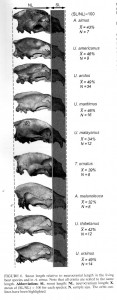
Snout lengths relative to skull length in living bears and in the GSFB.

They also ran a number of statistical analyses on the dimensions of the skulls of bears with other carnivores to see if differences in feeding behavior might be teased out this way. Feeding strategy, such as cat-like hypercarnivory or hyena-like bone-crushing, might be visible in the skull proportions. They concluded that the GSFB had a skull shape not like that of a cat, but more similar to modern brown bears (Ursus arctos). Brown bears are omnivorous and will certainly eat meat, but also have a significant amount of plant matter in their diet. So, those authors suggest the skull shape does not support a hypercarnivorous behavior.

Figueirido et al. also examined the claim that the GSFB had extremely long legs. They compared total limb length to overall body weight among modern bears and the GSFB. Their results suggest that the limb length is just what it should be for a bear of the overall size of the GSFB, and not especially long when compared to other bears.

Nothing in science is sacred and I applaud Figueirido et al. for critically looking at past interpretations. However, the answers to our questions continue to elude us. If they are right that the GSFB was not especially short-faced, and that the limbs were not especially long, and the skull was not especially cat-like, none of that really nails down the behavior of this giant species, as they point out. And bears in particular have a tremendous range of feeding adaptations and behaviors that do not fit the mold.

For example, modern bear behavior goes from one extreme represented by the polar bear, which lives on the arctic sea ice and eats almost nothing but seals, to the giant panda living in Asian forests and eats almost nothing but bamboo (but they too will eat meat if given the chance). And between those extremes is a lot of variation. There is really no reason to think that the GSFB was not also variable in its diet and behavior to some degree. But the isotope evidence is hard to argue with at the moment: they seem to have eaten a lot of meat.

The question remains though, how did they get their meat? Did they chase down their prey in long pursuits, or ambush them from short range, or act as the neighborhood bully and chase smaller carnivores from their kills? We don’t yet know but we will keep looking.

Related Posts:
GSFB, a North California Original
Denning Behavior in the GSFB
How Big was the GSFB?
Polar Bear Populations

BOCHERENS, H., S. D. EMSLIE, D. BILLIOU, AND A. MARIOTTI. 1995. Stable isotopes (C13, N15) and paleodiet of the giant short-faced bear (Arctodus simus). Comptes Rendus de l’Acadƒemie des Sciences Paris, 320, serie IIa:779-784.

EMSLIE, S. D., AND N. J. CZAPLEWSKI. 1985. A new record of giant short-faced bear, Arctodus simus, from western North America with a re-evaluation of its paleobiology. Contributions in Science, 371:1-12.

FIGUEIRIDO, B., J. A. PEREZ-CLAROS, V. TORREGROSA, A. MARTIN-SERRA, AND P. PALMQVIST. 2010. Demythologizing Arctodus simus, the ‘short-faced’ long-legged and predaceous bear that never was. Journal of Vertebrate Paleontology, 30(1):262-275.

KURTEN, B. 1967. Pleistocene bears of North America; 2. genus Arctodus, short-faced bears. Acta Zoologica Fennica, 117:1-60.

MATHEUS, P. E. 1995. Diet and co-ecology of Pleistocene short-faced bears and brown bears in eastern Beringia. Quaternary Research, 44:447-453.

UTM

In a couple of previous posts we have examined latitude and longitude in some detail, and explored in what format the numbers might be displayed on your handheld GPS unit. Here we will explore another commonly used coordinate system: UTM.

Latitude and longitude work well, but since they are all based upon circles, and because degrees are divided into groups of 60, the calculations required to work with them are unwieldy. It is frequently useful to have coordinates based upon plane rectangular geometry in our normal base 10 system. This can work well if the area in question is not too large, because then we can discount the curvature of the Earth. Over just a section of the Earth, the curve does not make a huge difference in error.

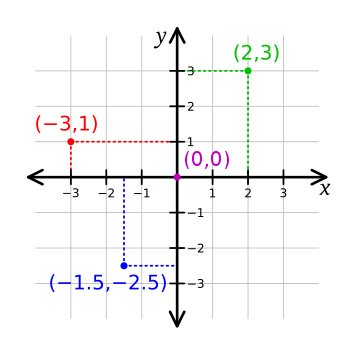
In order to do this, we must “flatten” the Earth to a plane, and when we do we can use the Cartesian coordinates that we all used in high school geometry class. It would be like flattening the peel of an orange. If you try to flatten the whole peel it makes a very irregular shape. But if you flatten a small piece it does fine. Then you can think of the x and y axes as east-west and north-south.

Cartesian coordinate system illustrated

The familiar Cartesian coordinate system showing how points can be assigned a distance along two axes from the origin point.

As you recall, every point on this plane can be described by two coordinates, one along each axis. And you can see in the  illustration that some of the points have negative values with respect to the origin (point 0,0). However, we can control how we place the coordinate system, and with the origin point outside of our area of interest all the points can be positive (east, north)—in the upper right-hand quadrant.

State of Kansas laid on top of a Cartesian coordinate form

The State of Kansas placed on the rectangular grid so that every point in the state will be positive with regard to the origin.

UTM coordinates, or Universal Transverse Mercator coordinates, are a rectangular plane system in metric units. Cartographers have taken swaths of each state and mathematically flattened them into a plane, assigned an origin southwest of each section, and laid out the resulting grid. Some of the smaller states are covered in a single swath, but the larger states must be broken into several zones so that the curvature of the Earth does not distort each map too much.

So, UTM coordinates have two components: their easting and northing values from the origin point in meters, and which state zone you are referring to. You can see a map of the zones here.

I have used UTM coordinates to good effect in my scientific work. When mapping a paleontological excavation, for example, we make all measurements in metric units. Since we are already measuring in metric units, every point in the dig site can easily be assigned its real-world UTM coordinate, instantly relating all points in the dig to any other point on the globe.

This means we can accurately and quickly plot the location of any fossil site, or even individual fossils, on a real-world map.

Related posts:
Recommended handheld GPS units
handheld GPS basics
Basic features in a handheld GPS
Geocaching

Mapping the Pratt Mammoth